Bicol to Tagalog Translator: Bridging Regional Dialects with Filipino
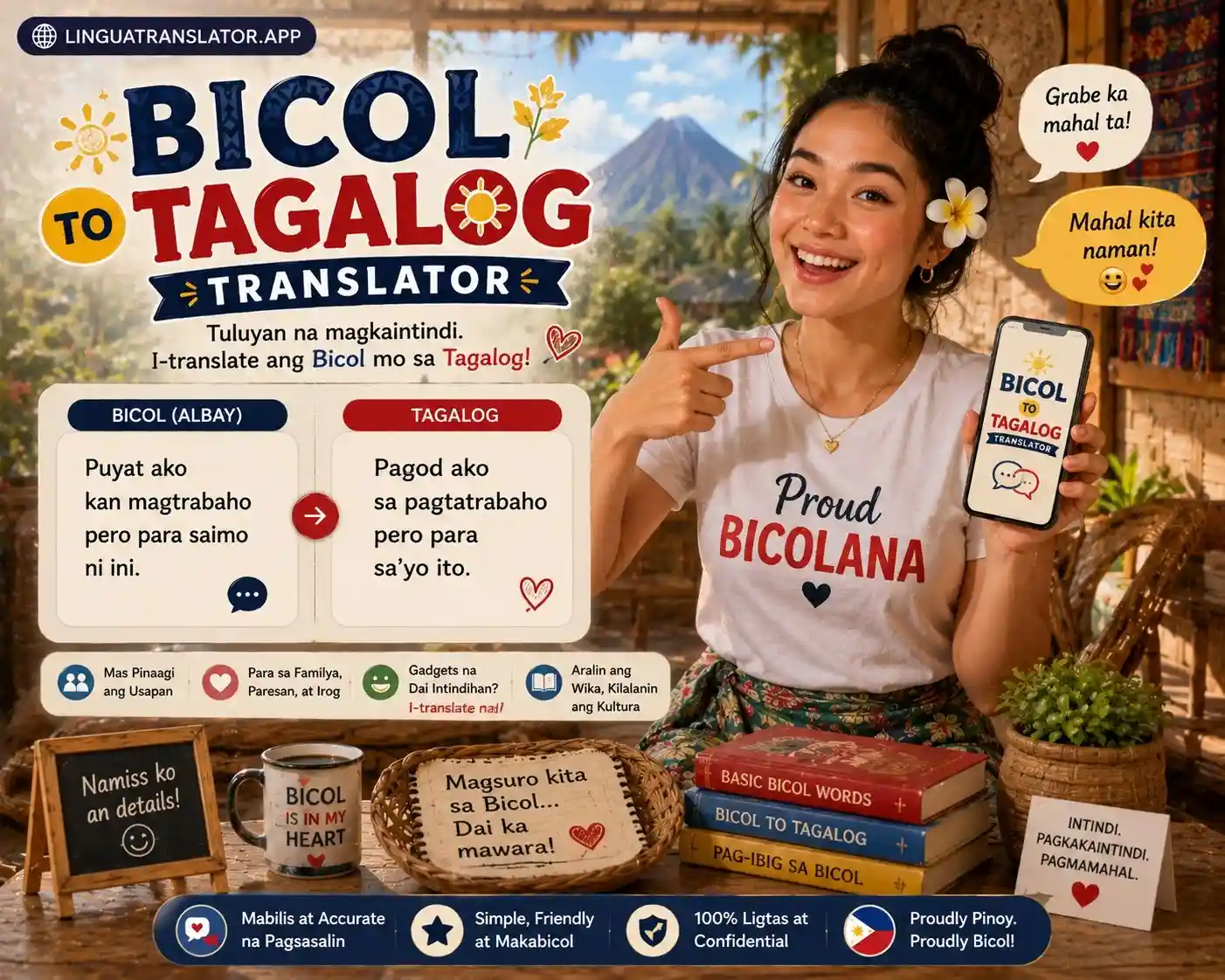
The Philippines is a land of diverse languages, and bridging the gap between the Bicolano regions and the Tagalog-speaking heartland is essential for commerce, education, and social connection. While Tagalog serves as the primary basis for Filipino—the national language—it often lacks the specific regional flavor found in the Bicol peninsula. Our Bicol to Tagalog translator is designed to handle these complexities, providing a seamless conversion that respects the grammatical structure of both tongues while ensuring the message remains clear and culturally relevant.
Text Translator
Diversity within the Bicolano Language Group
One reason why a specialized Bicolano to Tagalog converter is necessary is that “Bicol” is actually a macrolanguage consisting of several distinct varieties. Unlike Tagalog, which is relatively uniform, Bicol varies significantly across provinces:
Our AI-powered system is trained on these regional nuances, allowing it to recognize which variety of Bicol is being used and providing the most accurate Tagalog equivalent.
Is Tagalog the Same as Filipino?
While often used interchangeably, Filipino is the official national language of the Philippines, based largely on the Tagalog spoken in the Manila region. In contrast, Tagalog refers to the ethnic language of the Tagalog people. Our tool delivers results in standard Filipino/Tagalog, which is universally understood across all Philippine islands, making it ideal for students, travelers, and business professionals.
A Deep Dive into Bicolano Linguistic History
The history of Bicol and Tagalog is one of both shared ancestry and unique divergence. Both belong to the Austronesian language family, but they branched off into separate paths centuries ago. Historically, the Bicol region’s isolation led to a “dialect continuum” where neighboring towns developed their own unique vocabulary while maintaining a core Bicolano identity.
During the Spanish colonial era, both languages incorporated many Spanish loanwords—such as karne (meat) and braso (arm)—which actually increased their modern vocabulary similarity to roughly 51%. In the contemporary period, many Tagalog words like makulit and tampo have been absorbed into Bicolano, a process that our Bicolano to Tagalog translator handles with ease.
Comparative Vocabulary: Bicolano Dialects vs. Tagalog
To understand the accuracy of our tool, it is helpful to see how common words vary across the region:
| English | Central Bikol (Naga) | Albay Bikol | Rinconada | Tagalog (Filipino) |
| Good Morning | Marhay na aga | Marhay na aga | – | Magandang umaga |
| Beautiful | Magayon | – | – | Maganda |
| Delicious | Masiram | – | – | Masarap |
| Look | Hiling | Iling | – | Tingin |
| House | Harong | Baluy | – | Bahay |
| I love you | Namumutan ta ka | – | – | Mahal kita |
| Mother | Ina | – | Kag-igan na babayé | Ina / Nanay |
| Church | Simbahan | Simban | – | Simbahan |
Why Use Our AI-Powered Bicolano Translator?
RELATED POSTS
Pirate Speak Translator – Translate Your Text into Pirate Style
Turn any text into swashbuckling pirate speak. Perfect for themed parties, social posts, and creative writing with an authentic seafaring twist.
Parseltongue Translator – Speak the Serpent Tongue of the Dark Arts
Speak the language of the High Elves. Convert English into Tolkien’s most elegant Elvish tongue — beloved by Middle-earth scholars, fans, and tattoo seekers.
Old Tongue Translator – Speak the Ancient Language of the Age of Legends
Speak the language of the High Elves. Convert English into Tolkien’s most elegant Elvish tongue — beloved by Middle-earth scholars, fans, and tattoo seekers.