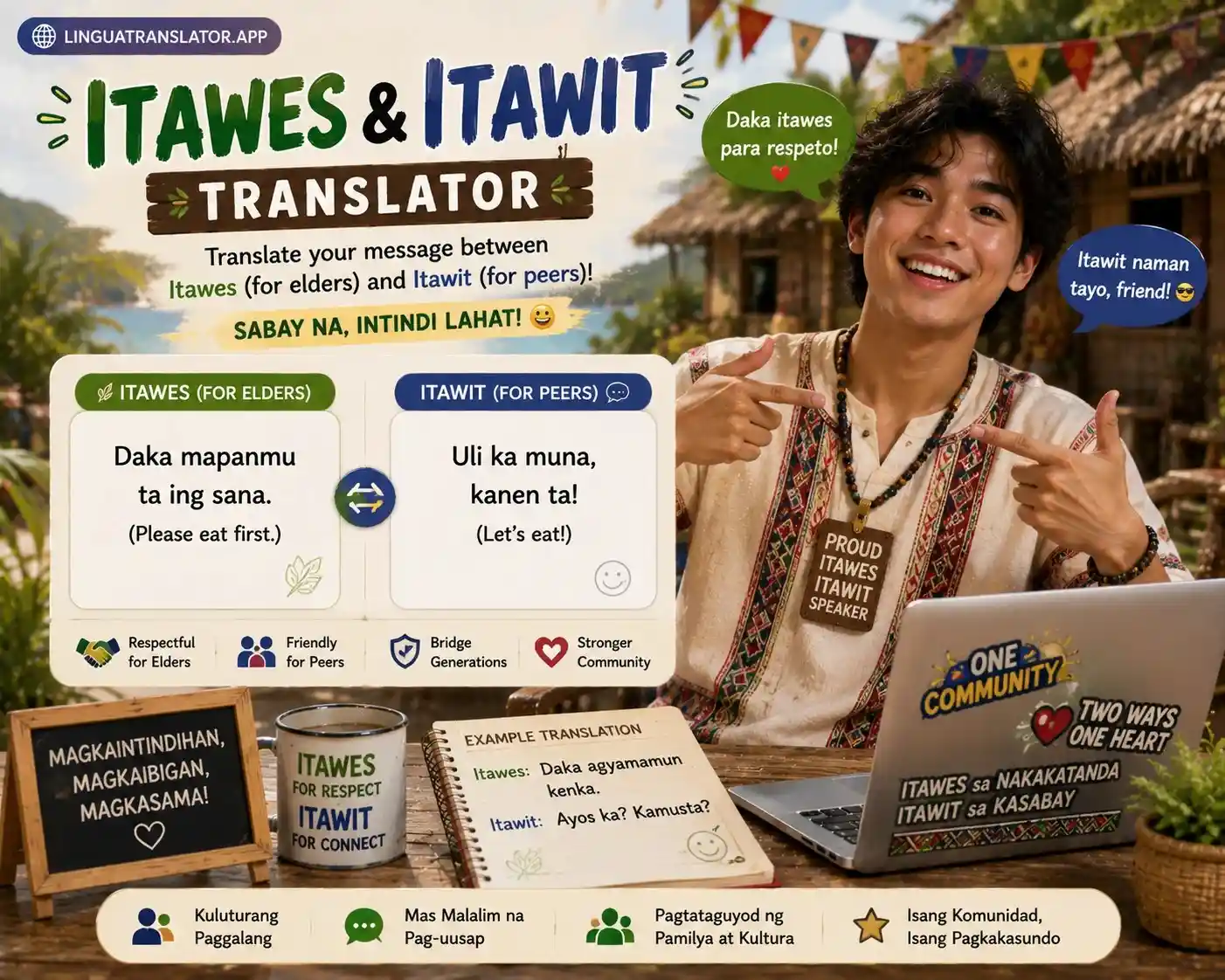
Free Itawes Translator – English to Itawes & Itawes to English
Experience the power of advanced neural machine learning to bridge the linguistic gap between English and the vibrant Itawes language. Whether you are a student, a traveler, or a developer, our AI-driven tool provides instant, high-accuracy translations that respect the unique phonetic and cultural nuances of the Cagayan Valley. Looking for other Philippine language translators? Also try our
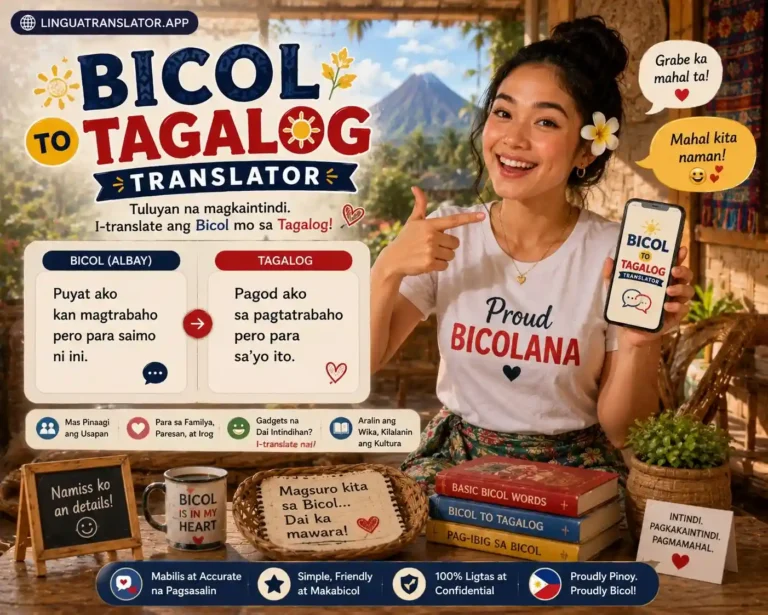
Bicol to Tagalog Translator for regional Filipino translation.
Fantasy Translator
Itawes
Translates text into Itawes (Itawis), a unique language of the Cagayan Valley, Philippines
Understanding the Itawes Language
To provide a truly authoritative translation experience, one must understand the technical and geographic landscape of Itawes (also spelled Itawis). This Austronesian language is a cornerstone of Northern Luzon’s heritage, and its complexity offers a unique study in linguistic modeling.
Speakers and Geographic Footprint
Itawes is primarily spoken in the Cagayan Valley of Northern Luzon, Philippines. As of 2005, the language was estimated to be spoken by approximately 189,000 people. The heart of the Itawes community is concentrated in towns situated along the lower Chico and Matalag rivers, where the language remains a vital part of daily life and commerce.
Dialects and Linguistic Neighbors
The language is not uniform across all regions; it features two primary dialects that define its internal variation:
- Itawis (Itawit): The standard variation used by the majority of speakers.
- Malaweg (Malaueg): A distinct dialectal variation found in specific municipalities.
Itawes belongs to the same family as its neighboring languages, Ibanag and Ilocano. Interestingly, due to centuries of trade and cultural proximity, many Itawes speakers are multilingual and also speak Ibanag.
Technical Phonology and AI Modeling
For AI translation, Itawes presents a sophisticated challenge compared to Tagalog. The phonology of the language allows for complex syllable onsets and codas. Most critically, Itawes is rich in minimal pairs—words that vary by only a single sound but carry entirely different meanings. Distinguishing these subtle shifts is essential for accurate AI modeling, and our tool is specifically trained to recognize these phonetic boundaries to ensure translations remain phonetically accurate and culturally appropriate.
Common Itawes Translation Examples
| English | Itawes (Itawis) | Tagalog |
| What is your name? | Anna yo ngahan mu? | Ano ang pangalan mo? |
| My name is ____. | Yo ngahan ku e ____. | Ang pangalan ko ay ____. |
| Nice to meet you. | Napia nga nakilala ta ka. | Ikinagalak kong makilala ka. |
| Good morning. | Mapia nga umma. | Magandang umaga. |
| Thank you. | Mabbalu. | Salamat. |
| How are you? | Kusta ka? | Kumusta ka? |
Why Translate English to Itawes?
Whether you are reconnecting with your cultural roots, communicating with Itawes-speaking family members, conducting fieldwork in the Cagayan Valley, or building multilingual applications for Northern Luzon communities, accurate Itawes translation is essential.
The Itawes language carries centuries of cultural heritage from one of the Philippines’ most historically significant river communities. Preserving and promoting access to this language through modern AI translation tools ensures that Itawes continues to thrive in the digital age.
Itawes vs Tagalog — Key Differences
Many people assume that Tagalog covers all Philippine languages, but Itawes is a distinct Austronesian language with its own grammar, vocabulary, and phonological system. While Tagalog is the basis of Filipino — the national language — Itawes is a regional language of Northern Luzon with unique features:
Itawes uses a focus system where the grammatical role of nouns is marked through verbal affixes rather than word order. This makes direct English to Itawes translation significantly more complex than English to Tagalog translation.
Itawes shares vocabulary with neighboring languages Ibanag and Ilocano due to centuries of cultural exchange, but remains mutually unintelligible with Tagalog.
Our translator is specifically trained on Itawes linguistic data rather than defaulting to Tagalog approximations, ensuring authentic and accurate results.
More Common Itawes Phrases
Here are additional everyday phrases to help you communicate in Itawes:
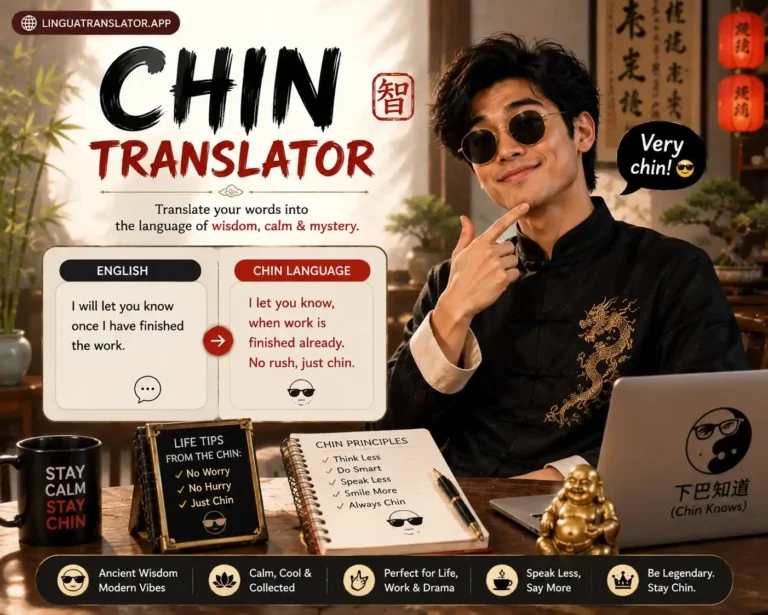
For rare and regional language translation, also explore our Chin Translator for Southeast Asian language conversion.
Ready to bridge the language gap? Use our free Itawes Translator above to instantly convert English to Itawes or Itawes to English. No sign-up required — just type and translate.
FAQs
RELATED POSTS
Bicol to Tagalog Translator: Bridging Regional Dialects with Filipino
Explore the vibrant beauty of the Bicolano language! Our translator helps you connect with the heart of Bicol by providing expressive Tagalog translations. Whether you’re learning the dialect or translating local stories, experience effortless regional communication today.
Chin Translator – Free Online Chin to English & English to Chin Translation Tool
Bridge the linguistic gap with free Chin to English and English to Chin translation. Supports the unique phonetic and cultural nuances of this Southeast Asian language family.