Parseltongue Translator – Speak the Serpent Tongue of the Dark Arts
In the Harry Potter universe, speaking Parseltongue marks you as either extraordinarily dangerous or extraordinarily rare. Only a handful of wizards in recorded history could do it — Salazar Slytherin, Voldemort, and Harry Potter himself, who inherited the ability when Voldemort’s Killing Curse rebounded and left a fragment of his soul behind. Unlike every other language on this page, Parseltongue was never formally constructed by a linguist. J.K. Rowling described it as a hissing, slithering sound that non-speakers hear as noise. What you will find below is the most authentic written representation of Parseltongue based on its attested appearances across the books, films, and Pottermore. Type your text and let the serpents speak. For another dark fantasy language, try our Black Speech of Mordor Translator.
Fantasy Translator
Parseltongue
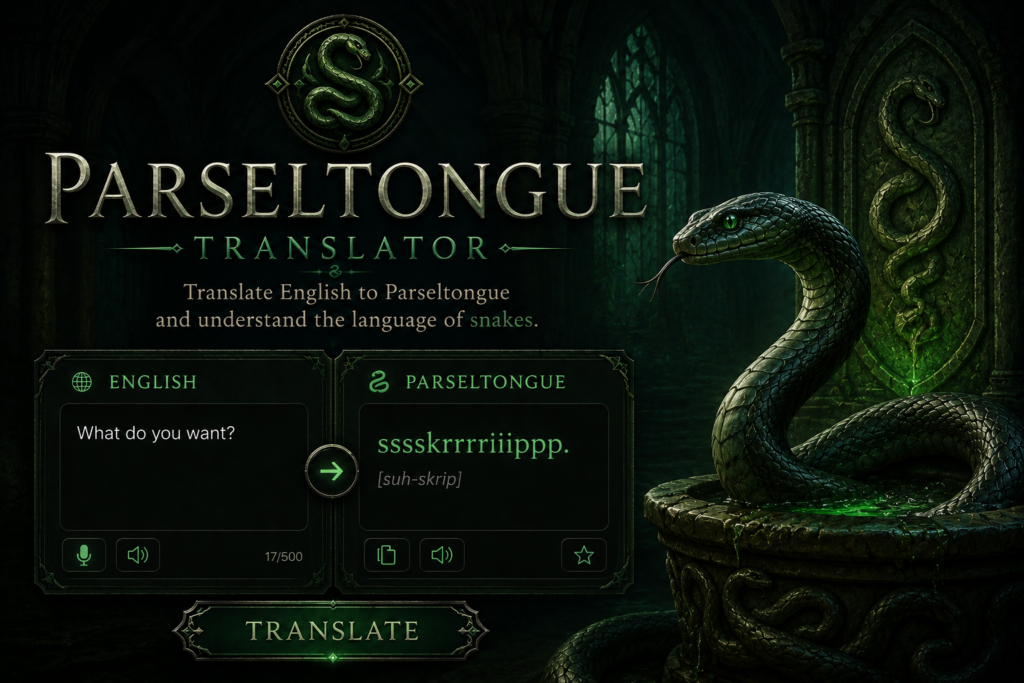
Translates text into Parseltongue, the snake language from Harry Potter
What Is Parseltongue and Where Did It Come From?
Parseltongue occupies a unique position among fictional languages. J.K. Rowling never commissioned a linguist to build it. She conceived it as an innate magical ability rather than a learnable language — you either hear snakes and understand them, or you hear hissing. This makes Parseltongue fundamentally different from Sindarin, Klingon, or Na’vi, all of which were built with complete grammars by professional linguists.
For the films, dialect coach Francis Nolan at Cambridge University worked with the actors to develop a consistent Parseltongue sound. The approach was phonetic — heavy on sibilants (s, sh, ss), fricatives, and soft consonants, with hard stops almost entirely absent. The result is a sound system that genuinely mimics the acoustic quality of snake movement and breath. What fans and scholars have since done is reverse-engineer a written system from the attested spoken phrases across eight films and the original stage production of Harry Potter and the Cursed Child.

Who Could Speak Parseltongue in Harry Potter?
Rowling was deliberate about keeping Parseltongue rare. In the entire history of the wizarding world she documented, only a small number of individuals possessed the ability — and the list itself tells a story about dark magic and inherited power.
Salazar Slytherin is the oldest confirmed Parselmouth in Hogwarts history, one of the four founders of the school and the man who built the Chamber of Secrets specifically to house the Basilisk. His descendants inherited the ability across generations. Voldemort — born Tom Riddle, a direct descendant of Slytherin through the Gaunt family — was the most powerful Parselmouth of the modern era. Harry Potter gained the ability not through bloodline but because Voldemort accidentally transferred a fragment of his soul into Harry as a Horcrux on the night he killed his parents. After that piece of Voldemort’s soul was destroyed in Harry Potter and the Deathly Hallows, Harry lost the ability entirely. Ron Weasley managed a single Parseltongue phrase in Deathly Hallows — having memorized the sounds Harry made — which opened the Chamber of Secrets. He did not understand it. He reproduced it phonetically, which Rowling used to make a point about the difference between speaking and mimicking.
Parseltongue in the Films – How the Sound Was Built
When Warner Bros. brought Parseltongue to screen, they faced a specific problem. The books describe it as pure hissing that sounds like noise to non-speakers. That works on a page. On film, the audience needs to hear something that sounds like a real language — structured enough to feel intentional, alien enough to feel inhuman.
Francis Nolan’s approach was to build Parseltongue around phonological consistency rather than vocabulary. Every phrase shares the same sound palette: sustained sibilants, nasalized vowels, soft fricatives, and a rhythm that mimics the movement of a snake — slow, deliberate, with sudden sharp intakes. Daniel Radcliffe has described the physical challenge of performing it: the sounds require the tongue to stay low and flat in the mouth, almost never touching the upper palate, which forces a genuinely different articulation from normal English speech. That physical constraint is why Parseltongue sounds convincing rather than performed — the mouth is actually doing something unusual to produce those sounds.

Attested Parseltongue Phrases From the Canon
Because Parseltongue was never formally constructed, what we have is a small set of phrases established across the films and supplementary material. These are the closest thing to an official Parseltongue vocabulary:
- Ssss… open — Harry’s command to the snake at the zoo in Philosopher’s Stone. Simple, direct, the first Parseltongue the audience hears.
- Speak to me, Slytherin, greatest of the Hogwarts Four — Harry’s command that opens the Chamber of Secrets entrance in the girls’ bathroom. The film renders this as a sustained hissing phrase.
- Ssilensss — Voldemort commanding Nagini to be silent. The doubling of consonants and stretched vowels is characteristic of how Parseltongue handles emphasis.
- Allow me to introduce you to your new master — Voldemort to Nagini in Deathly Hallows Part 1, spoken in Parseltongue with English subtitles. One of the longest Parseltongue sequences in the films.
From these attested examples, the consistent phonological rules emerge: hard consonants soften or disappear, vowels stretch and nasalize, and sibilants dominate every phrase.

The Cultural Weight of Parseltongue in Wizarding Society
Understanding Parseltongue requires understanding what it means socially in Rowling’s world. It is not neutral. In the wizarding community, being a Parselmouth carries an immediate presumption of dark alignment — because the only people known to possess the ability in living memory were Voldemort and his associates. When Harry speaks to the snake at the Dueling Club in Chamber of Secrets, the entire student body reacts with fear and suspicion. He did not do anything threatening. He simply spoke a language. But the language itself is the threat in wizarding culture.
Rowling uses this to make a broader point about prejudice — how an inherited trait (one Harry did not choose and did not know he had) becomes the basis for social judgment. It is one of the subtler pieces of world-building in the series, and it makes Parseltongue more narratively interesting than almost any other fictional language. It carries meaning beyond its words. For another language Tolkien built to carry moral weight through its sound, see our Black Speech Translator.
How Our Parseltongue Translator Works
Our translator applies the phonological rules extracted from every attested Parseltongue appearance across the Harry Potter films, books, and stage production. English input is converted by applying consistent sibilant substitution, consonant softening, vowel lengthening, and the rhythmic pacing that defines how Parseltongue sounds on screen. The output reads as Parseltongue is most commonly represented in fan canon and the broader Potterverse community — using doubled s letters, softened consonants, and stretched vowels to capture the serpentine quality of the language.
Because Parseltongue has no official written form or formal vocabulary list, this translator works differently from our Sindarin or High Valyrian translators which draw on documented canonical grammars. Think of the output as the most authentic written approximation possible given what canon actually gives us.

Frequently Asked Questions – Parseltongue Translator
Is Parseltongue a real constructed language like Klingon?
No — and this distinction matters. Parseltongue was never formally built by a linguist the way Klingon was by Marc Okrand or Na’vi by Paul Frommer. J.K. Rowling conceived it as a magical ability rather than a learnable language system. What exists is a phonological style developed for the films by dialect coach Francis Nolan at Cambridge — consistent enough to feel like a real language, but without documented vocabulary or grammar rules behind it.
Why did Harry Potter lose the ability to speak Parseltongue?
Harry could speak Parseltongue because Voldemort accidentally transferred a fragment of his soul into Harry on the night he killed his parents — making Harry an unintentional Horcrux. That soul fragment gave Harry access to abilities Voldemort possessed, including Parseltongue. When Voldemort cast the Killing Curse at Harry in the Forbidden Forest during Deathly Hallows, that soul fragment was destroyed. With it went Harry’s Parseltongue ability. He confirmed in post-series interviews that he can no longer speak or understand it.
Can Parseltongue actually be learned?
Not in the way Rowling defines it within her world — she was explicit that it is an innate magical gift, not a learnable skill. Ron’s moment in Deathly Hallows where he reproduces a Parseltongue phrase from memory actually reinforces this: he could mimic the sounds but had no understanding of what he said. In practical terms for fans, the phonological patterns are consistent enough that you can learn to produce Parseltongue-sounding speech — but there is no official vocabulary to actually translate meaning with.
Is Parseltongue considered dark magic?
In wizarding society, Parseltongue itself is not classified as dark magic — it is a hereditary trait. But because it passed through Slytherin’s bloodline and was most prominently associated with Voldemort in living memory, it carries a heavy social stigma. When Harry’s ability became public at Hogwarts, many students and adults interpreted it as evidence of dark alignment. Rowling uses this specifically to explore how inherited characteristics become the basis for prejudice — one of the series’ recurring themes.
Does Parseltongue have a written form?
No official written Parseltongue script exists in J.K. Rowling’s canon. The language is described as purely spoken — a hissing sound that Parselmouths produce instinctively and non-speakers hear as noise. The written representations you see online, including what our translator produces, are fan-developed phonetic approximations based on the sounds used in the films. The most common convention is doubling of s letters and softening hard consonants to capture the sibilant quality of the spoken language.
What other Harry Potter languages exist besides Parseltongue?
Rowling’s wizarding world includes several other magical communication systems. Mermish is the language of merpeople — described as a screeching, unintelligible sound above water that becomes comprehensible underwater. Gobbledegook is the language of goblins, heard briefly at Gringotts. Troll has its own crude language. None of these were developed beyond brief mentions, making Parseltongue by far the most fleshed-out non-human language in the Harry Potter universe.
RELATED POSTS
Quenya Translator – Convert English to Elvish (Tolkien) Language
Speak the language of the High Elves. Convert English into Tolkien’s most elegant Elvish tongue — beloved by Middle-earth scholars, fans, and tattoo seekers.
Free Sindarin Translator – Convert English to Sindarin Elvish
Speak the language of the High Elves. Convert English into Tolkien’s most elegant Elvish tongue — beloved by Middle-earth scholars, fans, and tattoo seekers.
Free Elvish Translator – Convert Any Text to Tolkien Elvish
Bring Middle-earth to life. Translate your name, vows, or story dialogue into authentic Tolkien-inspired Elvish — loved by cosplayers and fantasy writers.