Na’vi Translator – Speak the Language of Pandora
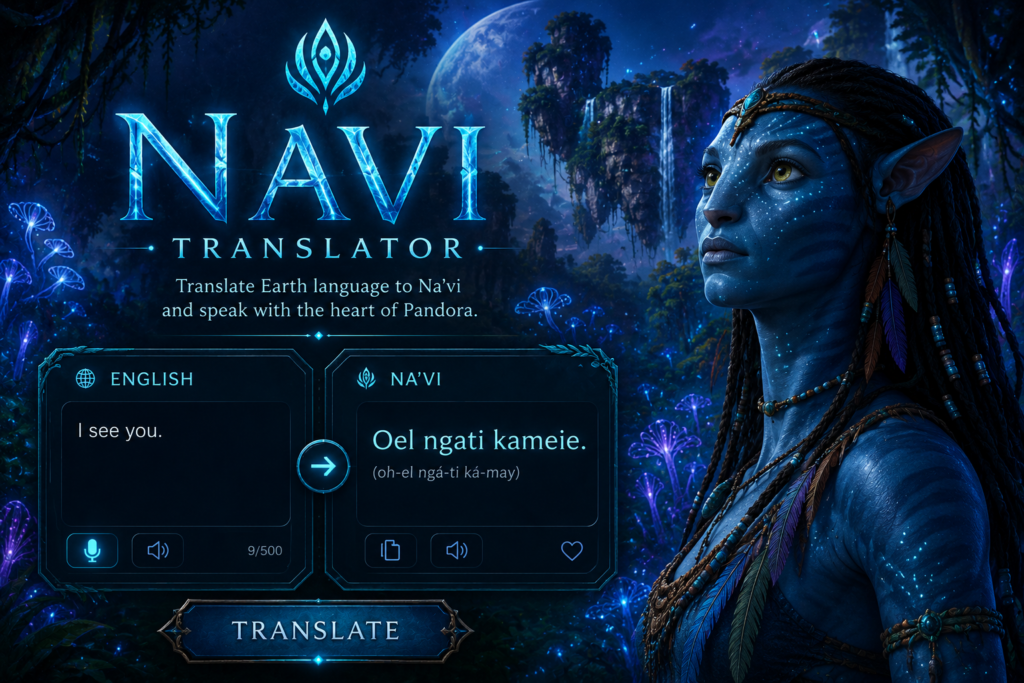
Oel ngati kameie — I see you. Those three words carry more meaning in Na’vi than most sentences do in English. The Na’vi language was built by linguist Paul Frommer for James Cameron’s Avatar (2009) and its sequel Avatar: The Way of Water (2022). It is the living tongue of the Na’vi people of Pandora — spiritual, nature-rooted, and built to sound genuinely alien yet beautiful. Type your English text below and connect with Eywa. If you enjoy constructed languages from science fiction, also explore our Klingon Translator — the warrior tongue from Star Trek.
Fantasy Translator
Na'vi
Translates text into Na'vi, the language of Pandora from Avatar
What Is the Na’vi Language?
Na’vi is a fully constructed language created by linguist Paul Frommer, a professor at the USC Marshall School of Business, commissioned by director James Cameron for the 2009 film Avatar. Cameron wanted a language that sounded genuinely alien but remained speakable by human actors. Frommer built Na’vi from scratch with a complete phonological system, grammar, and an original vocabulary that now exceeds 2,500 words. The language has ejective consonants — sounds made with a sharp burst of air — that exist in some African and Caucasian languages but feel exotic to most English speakers. After Avatar became the highest-grossing film in history, Na’vi attracted a global community of learners. The official learning resource is LearnNavi.org, and Frommer continues expanding the language for each new Avatar production. For another sci-fi constructed language, try our Klingon Translator.

Why Do People Translate to Na’vi?
Avatar is the highest-grossing film of all time — twice. The Na’vi language has a fanbase that spans every continent:
- Avatar fans want to understand what the Na’vi characters are saying beyond the subtitles and connect more deeply with Pandora’s culture.
- Theme park visitors — Pandora: The World of Avatar at Disney’s Animal Kingdom features Na’vi signage, audio, and cast members using the language.
- Language enthusiasts are drawn to Na’vi’s unique phonology — its ejective consonants and infixing verb system make it genuinely unlike any natural language.
- Cosplayers and convention goers preparing Na’vi costumes want authentic phrases to complete the experience.
- Environmentalists and spiritual communities connect with Na’vi because the language itself reflects a worldview centered on nature, balance, and interconnectedness.

Famous Na’vi Phrases You Should Know
Na’vi has produced some of the most emotionally resonant lines in modern cinema. Here are the most important ones:
- Oel ngati kameie — “I see you.” Not just visual seeing — the Na’vi use this to mean truly knowing and acknowledging another being’s soul. The most important phrase in the entire Avatar universe.
- Ngenga lu fpom srak? — “Are you well?” The standard Na’vi greeting.
- Eywa ngahu — “Eywa be with you.” A farewell invoking the Na’vi deity and the neural network connecting all life on Pandora.
- Oel ngati kameie, ma Eywa — “I see you, Eywa.” A prayer addressed to the goddess of Pandora.
- Tsleng lu — “It is a lie.” Direct, no-nonsense.
- Nga yawne lu oer — “I love you.” Literally “You are beloved to me” — a construction that reflects Na’vi’s subject-object-verb tendencies.
How Our Na’vi Translator Works
Our AI-powered Na’vi translator draws on Paul Frommer’s documented vocabulary and grammatical framework to convert English into Na’vi. Type your phrase into the box above and hit translate. The engine applies Na’vi’s unique infixing verb system — where tense, mood, and evidentiality markers are inserted inside verb roots rather than added before or after them. It also handles the tripartite agent-patient alignment, which treats the subject of a transitive verb differently from the subject of an intransitive one — a system that exists in very few natural languages. For concepts outside the current Na’vi vocabulary, the translator constructs the closest phonologically and grammatically consistent equivalent. Also explore our Sindarin Translator for another language built around a nature-connected people.

What Makes Na’vi Grammar Unique?
Paul Frommer designed Na’vi to be linguistically interesting and typologically rare. Here is what makes it stand out from every other constructed language:
- Infixing verbs — Na’vi is one of the few languages, real or constructed, that inserts grammatical markers inside a word root rather than adding prefixes or suffixes. The verb taron (to hunt) becomes t<ol>aron in the past tense.
- Tripartite alignment — Na’vi has three distinct grammatical cases for agents and patients of verbs: agentive, patientive, and dative. This is exceptionally rare among natural languages.
- Ejective consonants — Sounds like px, tx, and kx are produced with a glottal closure and air burst. They give Na’vi its distinctive sharp, percussive quality.
- Free word order — Because Na’vi uses case suffixes to mark grammatical roles, word order can shift freely for emphasis and poetic effect.
- Lenition — Like Sindarin and Welsh, Na’vi has a consonant mutation system where initial consonants change in certain grammatical environments.

Na’vi Across the Avatar Franchise
Na’vi has grown significantly with each new Avatar production:
- Avatar (2009) — Frommer created the language with around 1,000 words for the original film. Key phrases and the overall sound of the language were established here.
- Avatar: The Way of Water (2022) — New vocabulary was developed including terms for ocean life, the Metkayina reef clan’s culture, and their unique spiritual practices. The language expanded to reflect a completely different Na’vi environment.
- LearnNavi.org — The official fan-run learning community has grown to tens of thousands of active members. Frommer participates directly, answering grammar questions and confirming new vocabulary.
- Disney’s Pandora theme land — Opened at Animal Kingdom in 2017, featuring Na’vi audio, signage, and cast members trained in basic Na’vi phrases — bringing the language into the real world permanently.
- Upcoming Avatar sequels — Three more Avatar films are in development, each expected to expand the Na’vi language further.
Na’vi vs Other Sci-Fi Constructed Languages
| Language | Creator | Universe | Tone | Try It |
|---|---|---|---|---|
| Na’vi | Paul Frommer | Avatar | Spiritual, natural | You are here |
| Klingon | Marc Okrand | Star Trek | Harsh, warrior | Klingon Translator |
| Dothraki | David J. Peterson | Game of Thrones | Raw, nomadic | Dothraki Translator |
| High Valyrian | David J. Peterson | Game of Thrones | Noble, elegant | High Valyrian Translator |
Frequently Asked Questions – Na’vi Translator
Is Na’vi a real language you can learn?
Yes. Na’vi is a fully constructed language with over 2,500 documented words and a complete grammar system. The best place to start learning is LearnNavi.org, the official fan community where Paul Frommer himself participates. There are also grammar guides, vocabulary lists, and active discussion forums to help beginners.
Who created the Na’vi language?
Na’vi was created by Paul Frommer, a linguist and professor at the USC Marshall School of Business. James Cameron commissioned Frommer to build a complete language for the Avatar film series. Frommer has continued expanding Na’vi for each new Avatar production and remains the sole authority on the language’s canon.
What does “Oel ngati kameie” mean in Na’vi?
Oel ngati kameie means “I see you” in Na’vi. But in Na’vi culture this phrase goes far beyond visual perception — it means truly seeing and knowing another being at a soul level. It is the most important and emotionally loaded phrase in the entire Avatar universe and functions as both a greeting and a profound acknowledgment of another’s existence.
How many people speak Na’vi?
While no one speaks Na’vi as a native language, the LearnNavi.org community has tens of thousands of active members worldwide. Some dedicated learners have achieved conversational fluency. The community holds online events, produces Na’vi content, and even conducts conversations entirely in the language.
What are ejective consonants in Na’vi?
Ejective consonants are sounds produced by closing the glottis (the gap between vocal cords) and releasing a burst of air. In Na’vi they appear as px, tx, and kx. They give Na’vi its distinctive sharp, clicking quality. These sounds exist in some African, Caucasian, and Indigenous American languages but are absent from most European languages, making them feel genuinely alien to most Avatar viewers.
Is Na’vi used at Disney’s Avatar theme land?
Yes. Pandora: The World of Avatar at Disney’s Animal Kingdom in Orlando features Na’vi language throughout — in signage, ambient audio, and cast member interactions. Disney worked with Paul Frommer to ensure the language used in the park is accurate to canon. It is one of the few places on Earth where you can hear Na’vi spoken in a real-world environment.
RELATED POSTS
Free Elvish Translator – Convert Any Text to Tolkien Elvish
Bring Middle-earth to life. Translate your name, vows, or story dialogue into authentic Tolkien-inspired Elvish — loved by cosplayers and fantasy writers.
Free Sindarin Translator – Convert English to Sindarin Elvish
Speak the language of the High Elves. Convert English into Tolkien’s most elegant Elvish tongue — beloved by Middle-earth scholars, fans, and tattoo seekers.
Klingon Translator – Speak the Warrior Tongue of the Empire
Speak the language of the High Elves. Convert English into Tolkien’s most elegant Elvish tongue — beloved by Middle-earth scholars, fans, and tattoo seekers.