High Valyrian Translator – Speak the Language of Dragonlords
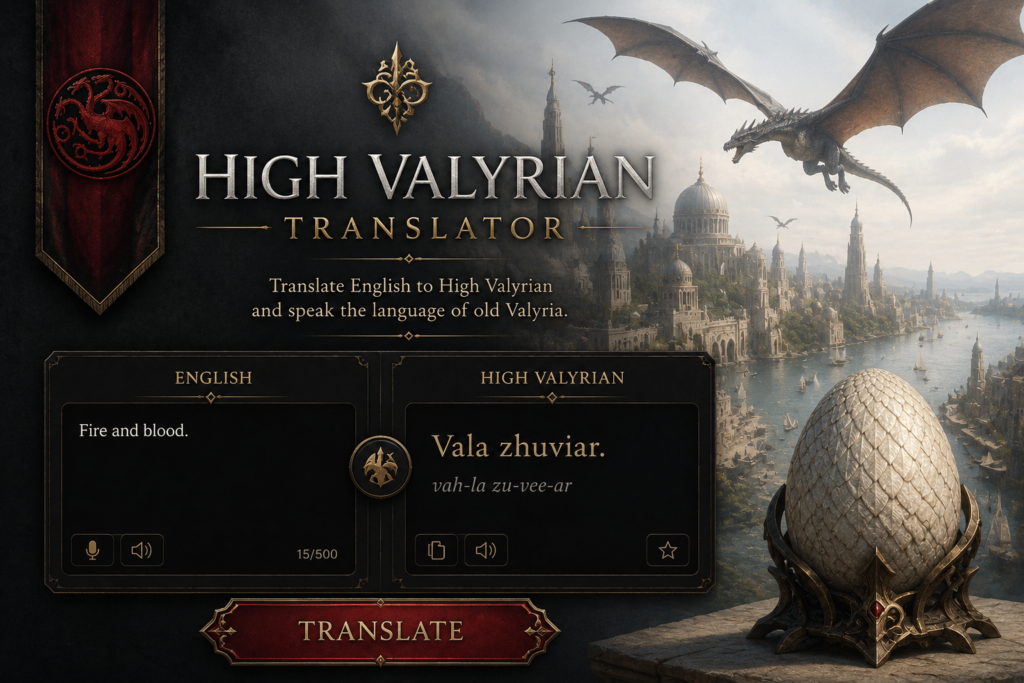
Valar Morghulis. All men must die — but before you go, learn to speak like the dragonlords of Old Valyria. High Valyrian is the ancient noble language from Game of Thrones and House of the Dragon, spoken by Daenerys Targaryen, the Masters of Astapor, and the priestesses of R’hllor. Created by linguist David J. Peterson for HBO, it is one of the most grammatically rich fantasy languages ever built. Type your English text below and our High Valyrian translator will convert it instantly. If you enjoy Game of Thrones languages, also check out our Dothraki Translator — the raw warrior tongue of the horse lords.
Fantasy Translator
High Valyrian
Translates text into High Valyrian, the dragonlord language from Game of Thrones
What Is High Valyrian?
High Valyrian is a constructed language built by linguist David J. Peterson for HBO’s Game of Thrones, first heard in Season 3. George R.R. Martin had included scattered Valyrian phrases in his A Song of Ice and Fire novels, and Peterson built a complete language around them. The result has over 2,000 documented words, a four-gender noun system, and a grammatical complexity that rivals Latin. It returned in HBO’s House of the Dragon (2022) with even more dialogue, and Peterson continues expanding the canon. Think of High Valyrian as the Latin of the Game of Thrones world — a language of empire, religion, and power that shaped every culture it touched. To compare it with the other major GOT language, visit our Dothraki Translator.

Who Spoke High Valyrian?
In the world of Westeros and Essos, High Valyrian was the language of the Valyrian Freehold — the greatest empire the world had ever seen before its destruction in the Doom of Valyria. After the Doom, the language survived in several forms:
- Pure High Valyrian — Used by scholars, priests of R’hllor, and the educated nobility across Essos. Daenerys speaks this form.
- Low Valyrian dialects — Regional versions spoken in the Free Cities like Braavos, Meereen, and Astapor. Each city developed its own variation over centuries.
- The Masters of Slaver’s Bay — Used High Valyrian as a language of trade and dominance over enslaved people.
- House Targaryen — Kept High Valyrian alive in Westeros as a mark of their dragonlord heritage, as seen throughout House of the Dragon.
Famous High Valyrian Phrases
You have heard these lines on screen. Here is what they actually mean:
- Valar Morghulis — “All men must die.” The most famous phrase in the entire franchise, used as a greeting between those who know its reply.
- Valar Dohaeris — “All men must serve.” The traditional response to Valar Morghulis.
- Dracarys — “Dragonfire.” Daenerys’s command to her dragons to breathe fire. One word. Maximum impact.
- Yn perzys issa — “This is fire.” A basic High Valyrian construction showing the language’s elegant simplicity in short phrases.
- Skoriot nyke jorrāelan — “Where do I love?” — an example of High Valyrian’s verb-heavy structure.
- Kirimvose — “Thank you.” Unlike Dothraki, High Valyrian does have words for gratitude — it is, after all, a civilized language.

How Our High Valyrian Translator Works
Our translator uses an AI engine trained on David J. Peterson’s documented High Valyrian canon to convert your English input into accurate High Valyrian. Paste your text into the box above and hit translate. The engine handles High Valyrian’s complex four-gender noun declension system (lunar, solar, terrestrial, aquatic), correct verb conjugations for tense and mood, and the formal register that defines the language. For words outside the documented vocabulary, the translator extends naturally using attested Valyrian roots — the same method Peterson uses when expanding the language for new scripts. Also try our Sindarin Translator for another aristocratic fantasy language with deep linguistic roots.

What Makes High Valyrian Grammar Special?
High Valyrian is grammatically one of the most sophisticated fantasy languages ever created. Here is what makes it stand out:
- Four grammatical genders — Lunar, solar, terrestrial, and aquatic. Every noun belongs to one, and adjectives must agree with it. This alone puts High Valyrian on par with Latin in complexity.
- Eight noun cases — Nominative, accusative, genitive, dative, locative, instrumental, comitative, and vocative. Each changes the noun’s ending and role in the sentence.
- Verb classes — Verbs are grouped into classes with different conjugation patterns depending on their root.
- No articles — High Valyrian has no words for “a” or “the.” Context and case endings do that work.
- Free word order — Because case endings carry grammatical meaning, word order is flexible and used for emphasis rather than grammar.
High Valyrian in Game of Thrones and House of the Dragon
High Valyrian appears throughout the entire Targaryen saga and grows more prominent with each new production:
- Game of Thrones Season 3 — Daenerys uses High Valyrian to trick the Masters of Astapor and free the Unsullied in one of the show’s most celebrated scenes.
- The Red Priestesses — Melisandre and other followers of R’hllor use High Valyrian in their prayers and prophecies, giving the language a religious weight.
- House of the Dragon (2022) — The language is used extensively by House Targaryen in their family interactions, dragon commands, and court proceedings, with Peterson creating significant new vocabulary for the show.
- Duolingo — High Valyrian became one of Duolingo’s constructed language courses, with over 1.4 million learners enrolling — making it one of the most studied fictional languages on Earth.
High Valyrian vs Other Fantasy Languages
How does High Valyrian compare to the other languages on Poly Translators?
| Language | Creator | Universe | Tone | Try It |
|---|---|---|---|---|
| High Valyrian | David J. Peterson | Game of Thrones | Noble, elegant | You are here |
| Dothraki | David J. Peterson | Game of Thrones | Raw, warrior | Dothraki Translator |
| Sindarin | J.R.R. Tolkien | Lord of the Rings | Melodic, ancient | Sindarin Translator |
| Klingon | Marc Okrand | Star Trek | Harsh, aggressive | Klingon Translator |
Frequently Asked Questions – High Valyrian Translator
Is High Valyrian a real language you can learn?
Yes. High Valyrian is a fully constructed language with documented grammar and vocabulary. Duolingo offers an official High Valyrian course with over 1.4 million enrolled learners. David J. Peterson has also shared extensive notes and resources through his blog and The Art of Language Invention.
Who created High Valyrian?
High Valyrian was created by linguist David J. Peterson for HBO’s Game of Thrones starting in 2011. Peterson was selected by the Language Creation Society through a competitive process. He also created Dothraki and has built languages for dozens of other film and TV productions.
What does “Dracarys” mean in High Valyrian?
Dracarys means “dragonfire” in High Valyrian. It is the command Daenerys Targaryen uses to order her dragons to breathe fire. The word comes from dracā (dragon) and is one of the most recognized words from the entire Game of Thrones franchise.
What does “Valar Morghulis” mean?
Valar Morghulis means “all men must die” in High Valyrian. Its traditional response is Valar Dohaeris — “all men must serve.” These two phrases are the most widely known High Valyrian expressions and appear across Game of Thrones, House of the Dragon, and even the A Song of Ice and Fire novels.
Is High Valyrian on Duolingo?
Yes. High Valyrian is one of Duolingo’s constructed language courses and has attracted over 1.4 million learners, making it one of the most studied fictional languages in the world. The course was developed with input from David J. Peterson himself.
How is High Valyrian different from Low Valyrian?
High Valyrian is the classical, pure form of the language as spoken in the Valyrian Freehold before the Doom. Low Valyrian refers to the regional dialects that evolved in the Free Cities after the Freehold’s collapse — each city like Braavos, Meereen, and Astapor developed its own version. High Valyrian is to Low Valyrian roughly what Latin is to modern Romance languages like French, Spanish, and Italian.
RELATED POSTS
Old Tongue Translator – Speak the Ancient Language of the Age of Legends
Speak the language of the High Elves. Convert English into Tolkien’s most elegant Elvish tongue — beloved by Middle-earth scholars, fans, and tattoo seekers.
Quenya Translator – Convert English to Elvish (Tolkien) Language
Speak the language of the High Elves. Convert English into Tolkien’s most elegant Elvish tongue — beloved by Middle-earth scholars, fans, and tattoo seekers.
Black Speech Translator – Speak the Dark Tongue of Mordor
Speak the language of the High Elves. Convert English into Tolkien’s most elegant Elvish tongue — beloved by Middle-earth scholars, fans, and tattoo seekers.