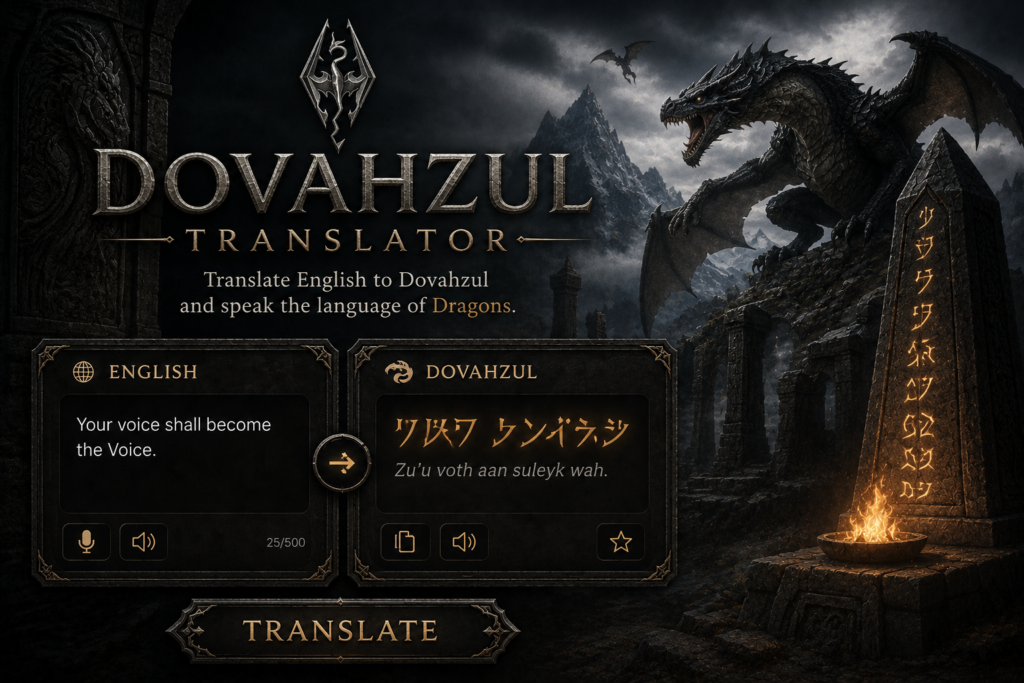
Dovahzul Translator – Speak the Dragon Tongue of Skyrim
FUS RO DAH. If you know what that means, you already know why Dovahzul matters. The Dragon Language from The Elder Scrolls V: Skyrim is not just a translation gimmick Bethesda slapped onto a video game. It is a working language system with its own alphabet, vocabulary, grammar, and a lore reason for existing that goes back thousands of years in Elder Scrolls history. The Dragonborn does not just speak it — he weaponizes it. Words of Power carved into ancient word walls across Skyrim become Shouts that bend reality. Type your text below and let the Thu’um speak. For another ancient language built around power and dominance, see our Black Speech of Mordor Translator.
Fantasy Translator
Dovahzul (Dragon Language)
Translates text into Dovahzul, the Dragon Language from The Elder Scrolls: Skyrim
What Is Dovahzul and Who Built It?
Dovahzul — literally “Dragon-Voice” in the language itself — was developed by Bethesda Game Studios for The Elder Scrolls V: Skyrim, released in 2011. The primary architects were Emil Pagliarulo (lead writer) and Michael Kirkbride, building on Elder Scrolls lore that had referenced dragon language in earlier games without fully developing it. What they created is genuinely systematic — a language with its own 34-character alphabet (each character resembling scratches a dragon’s claw might make on stone), consistent phonological rules, and a vocabulary documented across in-game word walls, NPC dialogue, and the official UESP wiki.
Dovahzul differs from every other language on Poly Translators in one key way: it was built by a game studio’s writing team rather than a professional linguist. This gives it a different character — it prioritizes dramatic impact and memorability over grammatical completeness. Every word in Dovahzul sounds like it should be shouted from a mountaintop. That is not an accident. Bethesda designed the language to function as both dialogue and gameplay mechanic simultaneously, which is a constraint no other fictional language creator has ever faced.

The Thu’um – When Language Becomes a Weapon
The most remarkable thing about Dovahzul is what it does within its fictional universe. The Thu’um — the Voice — is the ability to use Dovahzul words as physical forces. A dragon does not cast spells. It speaks reality into a different shape. When Alduin shouts Joor Zah Frul (Mortal Finite Temporary — the Dragonrend Shout), he is not describing mortality to his enemies. He is forcing the concept of mortality into their consciousness as a weapon.
This lore underpins why Dovahzul sounds the way it does. Every word was chosen for phonetic weight. Short, hard syllables that punch through air. Consonants that stop and release with force. Bethesda’s sound designers built the Shout audio around the language rather than the other way around — the words came first, the thunderclap was engineered to match them. The three most famous Shouts illustrate this perfectly: Fus Ro Dah (Force Balance Push), Yol Toor Shul (Fire Inferno Sun), and Lok Vah Koor (Sky Spring Summer — the Clear Skies Shout). Each three-word sequence builds in intensity, which is baked into how Dovahzul syllables are structured.

The Dovahzul Alphabet and Writing System
Dovahzul uses a dedicated alphabet of 34 characters, each representing a single phoneme. The script was designed to look like it was scratched into stone by dragon claws — angular, asymmetric, and slightly irregular in a way that suggests age and physicality rather than the flowing curves of Elvish scripts. Every word wall in Skyrim is inscribed in this alphabet, and players who took the time to learn it could read the walls directly rather than waiting for the in-game translation to appear.
The alphabet became one of the most learned fictional writing systems in gaming history. Within months of Skyrim’s 2011 release, fan communities had fully documented every character, cross-referenced every word wall, and built translation tools. The UESP (Unofficial Elder Scrolls Pages) wiki remains the authoritative reference, cataloguing every attested Dovahzul word with its in-game source. This community scholarship is why Dovahzul translation is possible at all — Bethesda released the language through gameplay rather than a reference document, and fans reverse-engineered the complete system from the game itself.
Key Dovahzul Words and Their Meanings
Dovahzul vocabulary is built around concepts central to dragon culture — power, time, elements, and combat. Here are some of the most significant words from the canon:
- Dovah — Dragon. The root word the language is named after.
- Zul — Voice. Combined with Dovah to give the language its name: Dragon-Voice.
- Dov — Dragonkind as a collective concept, distinct from individual dragons.
- Kiin — Born. Combined with Dovah: Dovahkiin — Dragonborn.
- Fus — Force. The first word of the Unrelenting Force Shout, and arguably the most recognized Dovahzul word globally.
- Tiid — Time. Central to the Slow Time Shout and deeply embedded in Elder Scrolls lore about dragon relationship with temporal existence.
- Krosis — Sorrow. One of the named Dragon Priests wears a mask with this name — Bethesda named their bosses in Dovahzul throughout the game.
- Paarthurnax — Ambition Overlord Cruelty. The name of the game’s most important dragon character, and a complete character description encoded in three Dovahzul roots.

Dovahzul Grammar – How the Dragon Tongue Actually Works
Bethesda did not publish a grammar guide for Dovahzul. What linguistically minded fans have reconstructed from the game’s dialogue, word walls, and NPC speech reveals a language that is grammatically spare but internally consistent.
Word order in Dovahzul is generally Subject-Object-Verb in formal constructions, though the small size of the documented vocabulary means many sentences are simply noun strings — which mirrors how the Shouts work as three-word concepts rather than full sentences. Nouns do not inflect for case the way Latin or High Valyrian nouns do. Verbs are minimally conjugated. The language achieves meaning primarily through word order and context rather than morphological change — a deliberately simpler system than Tolkien’s languages, suited to a species that communicates in shouts rather than conversation. Dragon names in Dovahzul are particularly revealing: they are always three-word compound descriptions of the dragon’s nature. Alduin means Destroyer Devour Master. Odahviing means Snow Hunter Wing. The naming convention encodes personality and role directly into identity.
Dovahzul Beyond Skyrim – The Language’s Cultural Reach
Skyrim sold over 30 million copies and remains one of the most replayed games ever made. Dovahzul reached an audience that dwarfs the viewership of most fantasy films and television series combined. The cultural impact is measurable in specific ways.
The main theme — Dragonborn by composer Jeremy Soule — features a choir singing in Dovahzul throughout. It became one of the most recognized pieces of video game music ever composed, introduced millions of players to the language aurally before they encountered it in text. Tattoos of the Dovahzul alphabet became common enough that professional tattoo artists began keeping the character reference chart on hand. The phrase Zu’u Dovahkiin (I am Dragonborn) became a cultural shorthand recognizable to anyone who played the game during the 2010s. University linguistics departments began using Dovahzul as a case study in constructed language design — specifically how vocabulary priorities reveal cultural values, since Dovahzul has extensive vocabulary for destruction and time but almost none for trade, family, or agriculture.

Frequently Asked Questions – Dovahzul Translator
What does “Fus Ro Dah” actually mean in Dovahzul?
Fus Ro Dah translates as “Force Balance Push” in Dovahzul. Each word represents one stage of the Unrelenting Force Shout — the first Shout the Dragonborn learns in Skyrim. In the game’s lore, learning all three words and unlocking the full Shout allows the Dragonborn to release a concentrated blast of force powerful enough to send enemies flying. The phrase became one of the most recognized lines in video game history within weeks of Skyrim’s 2011 release.
What does “Dovahkiin” mean?
Dovahkiin is a compound of two Dovahzul words: Dovah (Dragon) and Kiin (Born). Together they mean Dragonborn — the title given to a mortal who possesses the soul of a dragon and can absorb dragon souls to learn their Words of Power. It is the title of the player character in Skyrim and the name of the game’s main theme sung by a choir in Dovahzul.
Is Dovahzul a complete language?
Dovahzul is well-documented for a video game language but not complete in the way that Sindarin or Klingon are complete. The UESP wiki documents several hundred attested words drawn from word walls, NPC dialogue, and loading screen text across Skyrim and its DLC. Grammar has been partially reconstructed by the fan community from in-game evidence. Concepts outside dragon cultural experience — modern technology, abstract emotions, everyday domestic life — have no Dovahzul vocabulary because dragons simply never needed those words.
Can you read the word walls in Skyrim if you learn the alphabet?
Yes — and this is one of the most rewarding things about Dovahzul’s design. The word walls scattered across Skyrim’s dungeons and mountain peaks are inscribed in the actual Dovahzul alphabet, not decorative symbols. Players who learned the 34-character script could read the walls directly and discover the Words of Power inscribed on them before the in-game translation appeared. Bethesda built a real decipherable language into the environment specifically so that players who engaged with it would be rewarded with genuine comprehension.
What language is Dovahzul most similar to linguistically?
Dovahzul draws phonological inspiration primarily from Old Norse — the same source Tolkien drew on for Dwarvish and some aspects of his world-building. The hard consonants, the prevalence of short stressed syllables, and words like Thu’um and Sovngarde (Skyrim’s afterlife) reflect deliberate Norse influence. This fits Elder Scrolls lore since the Nord people of Skyrim are themselves modeled on Norse culture. The phonological overlap with Old Norse is what gives Dovahzul its sense of ancient weight without sounding like any modern language.
Do dragons in Elder Scrolls lore actually speak Dovahzul as their native language?
Yes — and the lore goes deeper than most players realize. In Elder Scrolls canon, dragons do not simply speak Dovahzul. They think in it. Their names are Dovahzul descriptions of their nature. Their Shouts are not spells they cast but literal expressions of their will imposed on reality through language. The Greybeards at High Hrothgar — monks who have spent their lives mastering the Thu’um — are considered dangerous to be near because even their whispered Dovahzul speech can cause tremors. The language and the power are not separate things in Elder Scrolls lore. That is what makes Dovahzul conceptually unique among every fictional language ever created.
RELATED POSTS
Alien Language Translator – Convert Text to Alien Language Free
Communicate beyond Earth. Transform any text into a mysterious, futuristic alien language style — perfect for sci-fi writers, game developers, and worldbuilders.
Klingon Translator – Speak the Warrior Tongue of the Empire
Speak the language of the High Elves. Convert English into Tolkien’s most elegant Elvish tongue — beloved by Middle-earth scholars, fans, and tattoo seekers.
Na’vi Translator – English to Na’vi Language | Poly Translators
Speak the language of the High Elves. Convert English into Tolkien’s most elegant Elvish tongue — beloved by Middle-earth scholars, fans, and tattoo seekers.