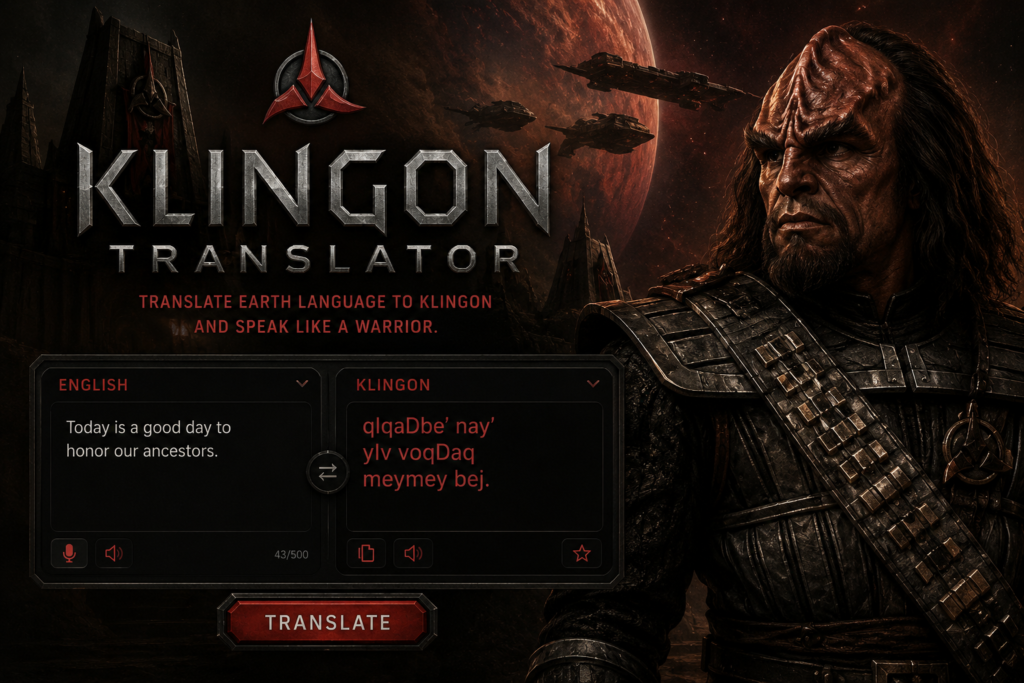
Klingon Translator – Speak the Warrior Tongue of the Empire
Qapla’! Welcome to the most fearless translator on the internet. Our Klingon translator converts your English text into tlhIngan Hol — the battle-hardened language of the Klingon Empire from Star Trek. Whether you want to challenge a rival, declare victory, or simply greet a fellow warrior, type your text below and let the Empire speak through you. Klingons don’t do small talk — so let’s get straight to it.
Fantasy Translator
Klingon
Translates text into Klingon, the warrior language from Star Trek
What Is the Klingon Language?
Klingon, or tlhIngan Hol, is a fully constructed language created by linguist Marc Okrand for Paramount Pictures. It first appeared in Star Trek III: The Search for Spock (1984) and has since grown into one of the most spoken constructed languages on Earth. Unlike many fictional languages, Klingon has a complete grammar, a dedicated dictionary (The Klingon Dictionary), and a global community of fluent speakers. It is maintained by the Klingon Language Institute (KLI), which has even published translations of Shakespeare and the Epic of Gilgamesh in tlhIngan Hol.

Why Do People Translate to Klingon?
Klingon is far more than a nerdy novelty — it has a passionate global fanbase with real-world use cases:
- Star Trek fans want to understand dialogue and immerse themselves deeper in the universe.
- Gamers playing Star Trek Online or other Trekverse games encounter Klingon constantly.
- Linguists & language enthusiasts study Klingon as a model of constructed language design — its OVS sentence order alone is fascinating.
- Content creators use Klingon phrases for videos, memes, and cosplay events.
- Challengers — because telling someone off in Klingon is objectively more satisfying.

Famous Klingon Phrases You Should Know
Klingon is packed with iconic expressions that any Trek fan will recognize:
- Qapla’ — “Success!” The most famous Klingon farewell and battle cry.
- nuqneH — “What do you want?” The standard Klingon greeting (they skip hello).
- tlhIngan maH! — “We are Klingon!” A declaration of warrior pride.
- Heghlu’meH QaQ jajvam — “Today is a good day to die.” The legendary pre-battle declaration.
- bIjatlh ‘e’ yImev — “Shut up.” Self-explanatory.
- HIja’ / HISlaH — “Yes.” (Klingons have two words for yes depending on formality.)

How Our Klingon Translator Works
Our AI-powered Klingon translator draws on the complete tlhIngan Hol vocabulary and grammatical framework documented by Marc Okrand. Simply type your English text into the box above and hit Translate. The engine maps English words and sentence structures to their closest Klingon equivalents, respecting the language’s unique OVS (Object-Verb-Subject) word order — the opposite of English. For concepts without direct Klingon vocabulary, the translator finds the closest warrior-appropriate equivalent, because Klingons always find a way to express themselves.

Klingon Grammar: What Makes It Unique?
Klingon is deliberately alien — Okrand designed it to feel as un-English as possible. Key features include:
- OVS word order — “The warrior killed the enemy” becomes “The enemy the warrior killed.”
- Verb prefixes — Klingon verbs carry information about both subject and object in their prefix, making single words entire sentences.
- No verb “to be” — Klingon adjectives act as verbs. “The ship is big” = “The ship bigs.”
- Harsh phonology — Klingon is full of guttural sounds: tlh, gh, Q, and H are all distinct consonants that English speakers find challenging.
- No word for “hello” — Warriors greet with demands, not pleasantries.

Klingon in Popular Culture
Klingon has transcended Star Trek to become a genuine cultural phenomenon:
- Star Trek franchise — Featured across every Trek series from TNG to Discovery and Strange New Worlds.
- The Klingon Language Institute — A real academic organization founded in 1992 that publishes a journal, HolQeD, and hosts annual conventions.
- Shakespeare in Klingon — The KLI has translated Hamlet and Much Ado About Nothing. Klingons famously claim Shakespeare was originally written in Klingon.
- Guinness World Record — Klingon holds the record as the world’s most spoken constructed language by number of fluent speakers.
- Google Translate — Even Google added Klingon as a supported language, cementing its mainstream status.

Frequently Asked Questions – Klingon Translator
Is Klingon a real language you can actually learn?
Yes! Klingon is a fully developed constructed language with complete grammar rules, a published dictionary, and thousands of speakers worldwide. You can learn it through the Klingon Language Institute, the Duolingo Klingon course, and Marc Okrand’s official The Klingon Dictionary.
Who created the Klingon language?
Klingon was created by American linguist Marc Okrand for Paramount Pictures. He developed it for Star Trek III: The Search for Spock (1984) and later published The Klingon Dictionary in 1985, which remains the definitive reference for the language.
What does “Qapla'” mean in Klingon?
Qapla’ means “Success!” in Klingon. It is the most commonly used Klingon expression and serves as both a farewell and a battle cry. The apostrophe at the end represents a glottal stop — a brief closure of the throat before the final vowel.
How do you say hello in Klingon?
Klingons don’t say hello. The closest equivalent is nuqneH, which literally means “What do you want?” — because Warriors have no time for pleasantries. It’s considered the standard Klingon greeting despite its blunt nature.
Is Klingon harder to learn than other constructed languages?
Klingon is considered one of the more challenging constructed languages due to its deliberately alien grammar — particularly its OVS word order (opposite to English), complex verb prefix system, and harsh phonology with sounds like tlh and Q that don’t exist in most natural languages.
Can I use Klingon translations for tattoos or artwork?
Absolutely! Klingon tattoos and artwork are popular among Trek fans. We recommend verifying your translation against The Klingon Dictionary or KLI resources for accuracy. Klingon is typically written in the pIqaD script for the most authentic visual appearance.
RELATED POSTS
Na’vi Translator – English to Na’vi Language | Poly Translators
Speak the language of the High Elves. Convert English into Tolkien’s most elegant Elvish tongue — beloved by Middle-earth scholars, fans, and tattoo seekers.
Old Tongue Translator – Speak the Ancient Language of the Age of Legends
Speak the language of the High Elves. Convert English into Tolkien’s most elegant Elvish tongue — beloved by Middle-earth scholars, fans, and tattoo seekers.
Yoda Style Language Translator – Speak Like a Jedi Master
Reverse your sentence structure, this tool will. Ancient wisdom and Jedi humor to any message, it adds.