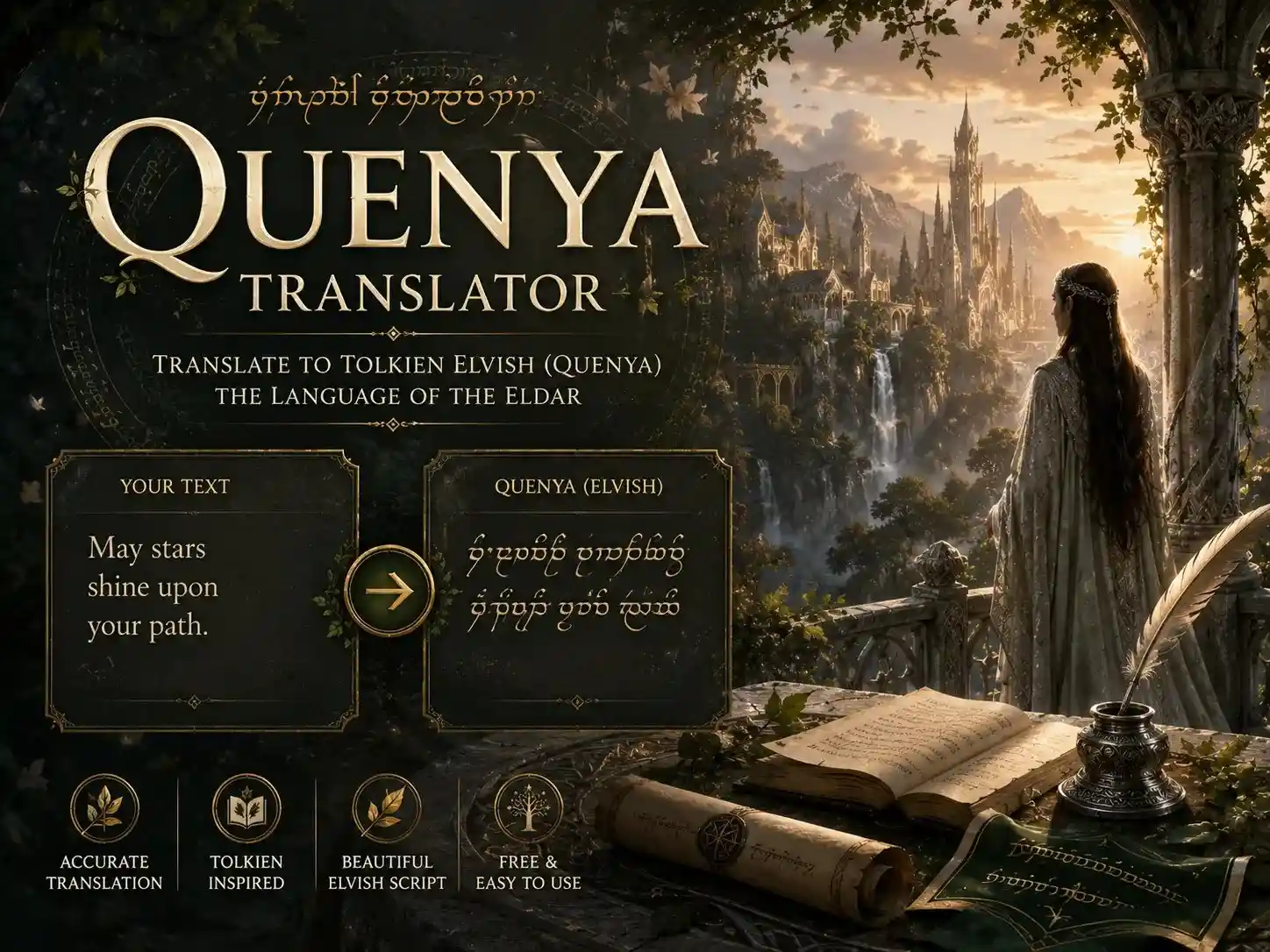
Free Quenya Translator – English to High Elvish (Tolkien) Converter
Experience the beauty of J.R.R. Tolkien’s most elegant language with our free online Quenya translator. Whether you are a dedicated Middle-earth scholar, a casual fan of The Lord of the Rings, or looking for unique Elvish translation for tattoos and creative writing, our AI-powered tool provides the most accurate conversion from English to High Elvish. Unlike generic translators, our system is specifically fine-tuned on the complex grammar, case systems, and vocabulary of High Elven (Quenya) as established in Tolkien’s linguistic notes. From famous phrases like “Namárië” to custom personal messages, translate your text instantly into the noble tongue of the Noldor and the Vanyar.
Want to understand what makes Quenya so special compared to other fantasy languages? Read our guide to the 10 Best Fantasy Languages for Writers and Worldbuilders.
Fantasy Translator
Quenya (Elvish)
Translates text into Tolkien's Elvish Quenya language
The Linguistic Legacy of High Elven: Beyond a Simple Translator
Quenya is not merely a “fictional language” but a sophisticated linguistic achievement that J.R.R. Tolkien developed over decades. Often referred to as “the Latin of the Elves,” it serves as the archaic, ceremonial language of the Noldor. Unlike Sindarin, which evolved through daily use in Middle-earth, Quenya remained preserved in its ancient form, used primarily for high poetry, lore, and formal greetings. Our Quenya translator aims to honor this complexity by moving beyond simple word-for-word substitution. We analyze the underlying grammar to ensure that your English inputs are transformed into a structure that feels native to the Undying Lands of Valinor.
The Complexity of English to Quenya Translation
One of the most significant hurdles in creating an accurate High Elvish translator is the “agglutinative” nature of Quenya. In English, we use many small words like “to,” “from,” and “with” to show relationships. In Quenya, these are often added as suffixes directly onto the noun. For example, the English phrase “from the stars” becomes a single, beautiful Quenya word: elenillo. Because our tool is fine-tuned on Tolkienian linguistics, it understands these “cases”—such as the Ablative and Allative—allowing it to condense complex English prepositions into the singular, flowing elegance that defines the Ancient Tongue.
Why Our AI-Driven Model Outperforms Generic Lists
Most online Elvish converters rely on static dictionaries that fail when they encounter modern English sentence structures. Our system uses a specialized mixture-of-experts architecture that has been trained on a diverse corpus of Tolkien’s linguistic notes, including the Etymologies and the Vinyar Tengwar. This allows the model to handle “code-switching” and modern terminology by finding the closest Quenya roots to create a logical translation. Whether you are translating a name for a character or a heartfelt message for a gift, our Quenya English converter provides a level of grammatical nuance that simple lists cannot match.
Creative Uses for High Elvish Translation in 2026
The demand for Quenya translation has grown far beyond the pages of The Silmarillion. Today, fans utilize our tool for a variety of creative endeavors:
Best Practices for Accurate Elven Results
To achieve the highest quality English to High Elvish results, we recommend a “Context-First” approach. Because Quenya is a highly formal language, it often lacks direct equivalents for modern technology or internet slang. When using the translator, try to rephrase your message into more “timeless” or poetic English. Instead of saying “Check your email,” try “Behold the message sent to you.” This allows the AI to select the most appropriate archaic roots, ensuring your translation sounds like it belongs in the Third Age of Middle-earth rather than a 21st-century office.
Because the translator is designed for both beginners and advanced users, it’s accessible to anyone interested in Elvish, regardless of prior knowledge.
Common Quenya Words and Phrases
Learning even a handful of Quenya words deepens your appreciation of Tolkien’s world and helps you use the translator more effectively. Here are some of the most beautiful and commonly used Quenya words:
These words appear frequently in The Lord of the Rings and The Silmarillion, and using them as anchor points helps you craft more authentic Quenya phrases.
Quenya vs Sindarin
Quenya vs Sindarin — What Is the Difference?
Tolkien created two major Elvish languages — Quenya and Sindarin — and understanding the difference helps you choose the right one for your creative project.
Quenya is the High Elvish tongue — ancient, ceremonial, and musical. Think of it as the Latin of Middle-earth. It was spoken by the Noldor in Valinor and preserved as a language of lore, poetry, and formal speech. It features long flowing vowels and complex grammatical cases.
Sindarin is the Grey Elvish tongue — the living, everyday language of the Elves of Middle-earth. It draws from Welsh and sounds softer and more lyrical. Most of the Elvish spoken in Peter Jackson’s films is Sindarin.
If you want something ancient, ceremonial, and poetic — use Quenya. If you want something that feels like living speech — use our Elvish Translator for Sindarin-inspired translation.
FAQs
RELATED POSTS
Na’vi Translator – English to Na’vi Language | Poly Translators
Speak the language of the High Elves. Convert English into Tolkien’s most elegant Elvish tongue — beloved by Middle-earth scholars, fans, and tattoo seekers.
Free Robot Translator – Convert Text to Robotic Language
Strip emotion, add precision. Convert any text into flat, mechanical robot language for AI character dialogue and sci-fi content.
Free Sindarin Translator – Convert English to Sindarin Elvish
Speak the language of the High Elves. Convert English into Tolkien’s most elegant Elvish tongue — beloved by Middle-earth scholars, fans, and tattoo seekers.