Old Tongue Translator – Speak the Ancient Language of the Age of Legends
Carai an Caldazar. For the honor of the Red Eagle. The Old Tongue from Robert Jordan’s Wheel of Time is not a language anyone in the Third Age fully speaks anymore. That is the point. It is the remnant of a civilization so advanced it makes the current age look primitive — the Age of Legends, when men and women could channel the One Power freely, when the Dark One was sealed away, and when a single language unified the entire world. What survives in the Third Age are fragments. Battle cries. Titles. Oaths spoken by people who no longer fully understand what they are saying. That gap between the words and their meaning is what makes the Old Tongue one of the most narratively interesting constructed languages in fantasy literature. Type your text below and speak as the heroes of a lost age once spoke. For another ancient language that carries the weight of a fallen civilization, try our High Valyrian Translator.
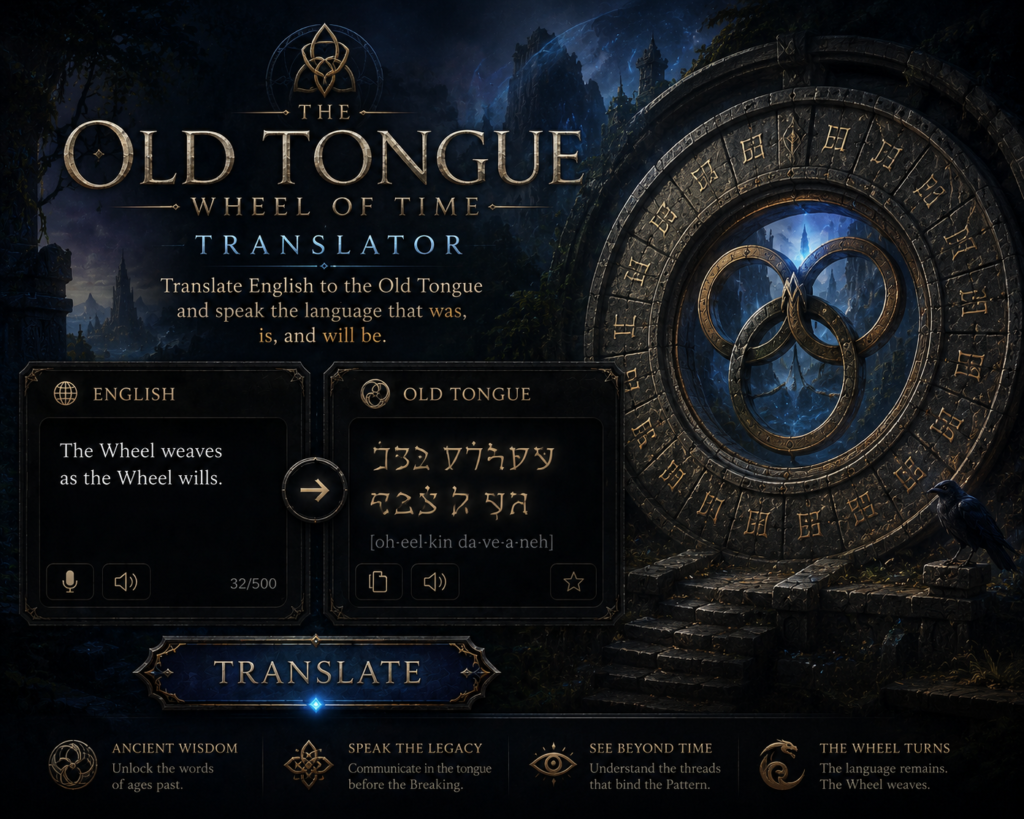
Fantasy Translator
The Old Tongue (Wheel of Time)
Translates text into the Old Tongue from Robert Jordan's Wheel of Time
What Is the Old Tongue and Who Created It?
The Old Tongue is the constructed language Robert Jordan developed for his fourteen-volume Wheel of Time series, beginning with The Eye of the World in 1990. Unlike the other languages on Poly Translators, the Old Tongue was never handed to a professional linguist or built as a standalone system. Jordan — whose real name was James Oliver Rigney Jr., a military historian with a deeply systematic approach to world-building — developed it himself over the course of the series, seeding vocabulary, phrases, and grammatical patterns gradually across millions of words of fiction.
The result is a language that feels genuinely ancient precisely because it was never fully revealed. Jordan understood instinctively what Tolkien understood about Sindarin — that a language feels real when it has depth you cannot fully see. The Old Tongue appears in battle cries, in the names of ancient organizations like the Aes Sedai and the Atha’an Miere, in the titles of the Forsaken, and in fragments of song and poetry that characters recite without full comprehension. Brandon Sanderson, who completed the series after Jordan’s death in 2007, continued using the language consistently with Jordan’s established patterns. The Amazon Prime series released in 2021 brought further Old Tongue dialogue to screen, and linguistic fans have continued expanding the documented vocabulary from every new source.

The Old Tongue as a Dead Language Within Its Own World
What separates the Old Tongue from every other language on this site is its in-world status as a dying language. In the Third Age — the era of the main Wheel of Time narrative — the Old Tongue is not anyone’s native language. It has not been for thousands of years. Characters who speak it fluently are remarkable precisely because fluency is rare. Most people in the Third Age know individual words or set phrases the way educated Europeans in the Middle Ages knew Latin — enough to recognize and recite, not enough to converse.
This creates something linguistically unusual. The Old Tongue in the books functions simultaneously as a mark of education and ancient lineage (the Aes Sedai use it in formal contexts), a battle language (soldiers shout Old Tongue war cries they have memorized phonetically without understanding), and a source of dramatic irony (readers who have learned the vocabulary understand what characters are saying to each other without knowing it). Jordan uses this layering deliberately. When Mat Cauthon begins speaking Old Tongue fluently after his memories from past lives surface, it signals a fundamental change in who he is at a soul level — the language becomes a plot device rooted in genuine linguistic logic. For another language that survived the fall of its originating civilization, compare our High Valyrian Translator — the Latin of the Game of Thrones world.
Key Old Tongue Phrases From the Wheel of Time
Jordan seeded the Old Tongue throughout the series in specific, memorable contexts. These are the most significant attested phrases:
- Carai an Caldazar — “For the honor of the Red Eagle.” The battle cry of Manetheren, the ancient kingdom whose people became the Two Rivers folk. When Moiraine speaks this to the villagers of Emond’s Field in The Eye of the World, grown men weep without knowing why — the Old Tongue reaching across centuries to touch blood memory.
- Carai an Ellisande — “For the honor of the Rose of the Sun.” The full Manetheren battle cry, paired with the above.
- Al Ellisande — “For the Rose of the Sun.” A shortened oath form used by Manetheren’s people.
- Mordero daghain pas duente cuebiyar — “Nothing can harm me, the grave is my bed.” An Old Tongue saying that appears in Mat’s story arc.
- Dovie’andi se tovya sagain — “It’s time to toss the dice.” Mat’s personal catchphrase, spoken in Old Tongue — fitting for a character whose past lives include an Age of Legends general.
- Aes Sedai — “Servants of All” in the Old Tongue. The title of the female channelers who guide the world’s politics has been used so long it no longer feels like a phrase to most characters — but it is a complete Old Tongue sentence.
- al’Thor — The prefix al’ in Two Rivers surnames is a corruption of the Old Tongue word for “son of” — a piece of language so degraded by time that the characters bearing it do not know what their own names mean.

The Grammar and Structure of the Old Tongue
Jordan never published a grammar guide for the Old Tongue. What fans and linguists have reconstructed from the attested material across fourteen books and the Amazon series reveals a language with several consistent features.
The Old Tongue shows clear inflectional morphology — word endings change to indicate grammatical role, similar to Latin or High Valyrian. The word an functions as a preposition meaning “of” or “for.” The prefix al’ marks descent or belonging. Compound constructions are common — Asha’man means “Guardian” or literally “Dedicated/Chosen Man,” combining roots that appear separately elsewhere in the vocabulary. Phonologically, the Old Tongue favors open vowels, soft consonants, and a flowing quality that Jordan described as sounding like “water over stones” — a deliberate contrast to the harsh sounds of Trolloc language and the guttural speech of the Shadowspawn. The Fan sites Encyclopaedia WoT and the Wheel of Time Wiki have compiled the most complete Old Tongue glossaries available, drawing on every confirmed use across the entire series.
The Old Tongue in the Amazon Prime Series
When Amazon’s Wheel of Time series premiered in November 2021, showrunner Rafe Judkins and the production team made a deliberate choice to expand Old Tongue dialogue beyond what the books contain. This required working from Jordan’s established vocabulary and extrapolating new phrases consistent with his patterns — the same challenge translators and fan linguists face.
The results were largely well received by the fan community, particularly the Aes Sedai ritual dialogue and the expanded use of Old Tongue in Warder bonding ceremonies. Rosamund Pike, who plays Moiraine Damodred, has spoken in interviews about the care taken to ensure Old Tongue pronunciation was consistent across the cast — a challenge given that no living person speaks it natively and no audio reference existed beyond what the production itself created. Season 2 deepened this with extended Seanchan dialogue drawing on Old Tongue roots, showing how the language evolved differently in a culture that crossed the Aryth Ocean and developed in isolation for three thousand years. For fans who want to explore another fictional language that was expanded significantly for a television adaptation, our Dothraki Translator covers a language that went through a similar process for HBO.

Old Tongue Compared to Other Fantasy Languages on Poly Translators
| Language | Creator | Canon Status | In-World Status | Try It |
|---|---|---|---|---|
| Old Tongue | Robert Jordan | Partial — scattered across 14 books | Dead language, fragments survive | You are here |
| High Valyrian | David J. Peterson | 2,000+ words documented | Classical language, dialects survive | High Valyrian Translator |
| Sindarin | J.R.R. Tolkien | Extensive — 50 years of development | Living language in Third Age | Sindarin Translator |
| Black Speech | J.R.R. Tolkien | Very limited — one inscription | Active — used by Sauron and Orcs | Black Speech Translator |
Frequently Asked Questions – Old Tongue Translator
Who created the Old Tongue in Wheel of Time?
The Old Tongue was created by Robert Jordan (real name James Oliver Rigney Jr.) and developed gradually across the fourteen Wheel of Time novels published between 1990 and 2013. Unlike most fictional languages, it was never handed to a professional linguist — Jordan built it himself as a military historian with a systematic approach to world-building. Brandon Sanderson continued developing it consistently when he completed the series after Jordan’s death in 2007, and the Amazon Prime series added further dialogue in 2021 and 2022.
What does “Aes Sedai” mean in the Old Tongue?
Aes Sedai means “Servants of All” in the Old Tongue. It is the title of the female channelers of the One Power who have guided world events from the White Tower in Tar Valon for three thousand years. The phrase has been in continuous use so long that most characters in the Third Age no longer think of it as an Old Tongue phrase at all — it simply is the name of the organization. This is one of Jordan’s most elegant pieces of language world-building: a complete sentence hiding in plain sight as a proper noun.
Why does Mat Cauthon speak the Old Tongue?
Mat begins speaking Old Tongue fluently — including battle commands and tactical language he has never studied — after his experience in the ter’angreal in Rhuidean and his encounter with the *eelfinn* and *aelfinn* in the Tower of Ghenjei. The explanation in Wheel of Time lore is that Mat’s soul carries memories from dozens of past lives spanning the Age of Legends, and those memories surface as Old Tongue fluency. His past selves spoke it natively. This is why Mat’s Old Tongue is specifically military in character — his past lives were soldiers and generals, and the vocabulary that surfaces reflects who he has been across the turning of the Wheel.
Is the Old Tongue a complete language you can learn?
Not completely — but more is documented than most people realize. The Wheel of Time Wiki and Encyclopaedia WoT have compiled several hundred attested Old Tongue words and phrases from across the entire series. Grammatical patterns have been partially reconstructed by the fan community. It is not learnable to fluency the way Klingon is, but dedicated fans have achieved enough command of it to translate short passages and compose new phrases consistent with Jordan’s patterns.
What does “Dovie’andi se tovya sagain” mean?
Dovie’andi se tovya sagain means “It’s time to toss the dice” in the Old Tongue. It is Mat Cauthon’s personal catchphrase and one of the most recognized Old Tongue phrases among Wheel of Time fans. It reflects Mat’s character perfectly — a man whose taveren nature and past-life memories as a military commander express themselves through the language of gambling and chance. The phrase appears at key moments throughout the series when Mat is about to do something reckless and decisive.
How is the Old Tongue different from the common tongue in Wheel of Time?
The common tongue — the everyday language of the Third Age — evolved from the Old Tongue over three thousand years following the Breaking of the World. The relationship is similar to how modern English evolved from Old English or how French evolved from Latin — recognizable roots, but transformed beyond everyday comprehension. Place names, family names (the al’ prefix in Two Rivers surnames), and organizational titles like Aes Sedai are the most visible remnants of the Old Tongue embedded in common speech. Most Third Age characters encountering pure Old Tongue hear it as a foreign language despite their ancestors having spoken it natively.
RELATED POSTS
Na’vi Translator – English to Na’vi Language | Poly Translators
Speak the language of the High Elves. Convert English into Tolkien’s most elegant Elvish tongue — beloved by Middle-earth scholars, fans, and tattoo seekers.
Anglo-Saxon Translator – Convert Text Into Authentic Old English
Explore the deep roots of English. Convert modern text into the ancient, powerful style of Old English — perfect for history lovers.
High Valyrian Translator – English to High Valyrian | Poly Translators
Speak the language of the High Elves. Convert English into Tolkien’s most elegant Elvish tongue — beloved by Middle-earth scholars, fans, and tattoo seekers.