
Anglo-Saxon Translator – Convert Text Into Authentic Old English
Anglo-Saxon, also known as Old English, is the earliest form of the English language spoken in England from approximately 450 to 1100 AD. It is a rich, expressive, and historically significant language, full of strong verbs, poetic rhythm, and vivid imagery. Modern English evolved from this language, but reading or writing in Old English still feels like stepping back into a world of epic tales, heroic warriors, and noble courts. Our Anglo-Saxon Translator allows you to take modern text and convert it into authentic Old English, making your writing feel historical, epic, and deeply immersive. Whether you are a student, historian, writer, or gamer, this tool brings Anglo-Saxon to life.
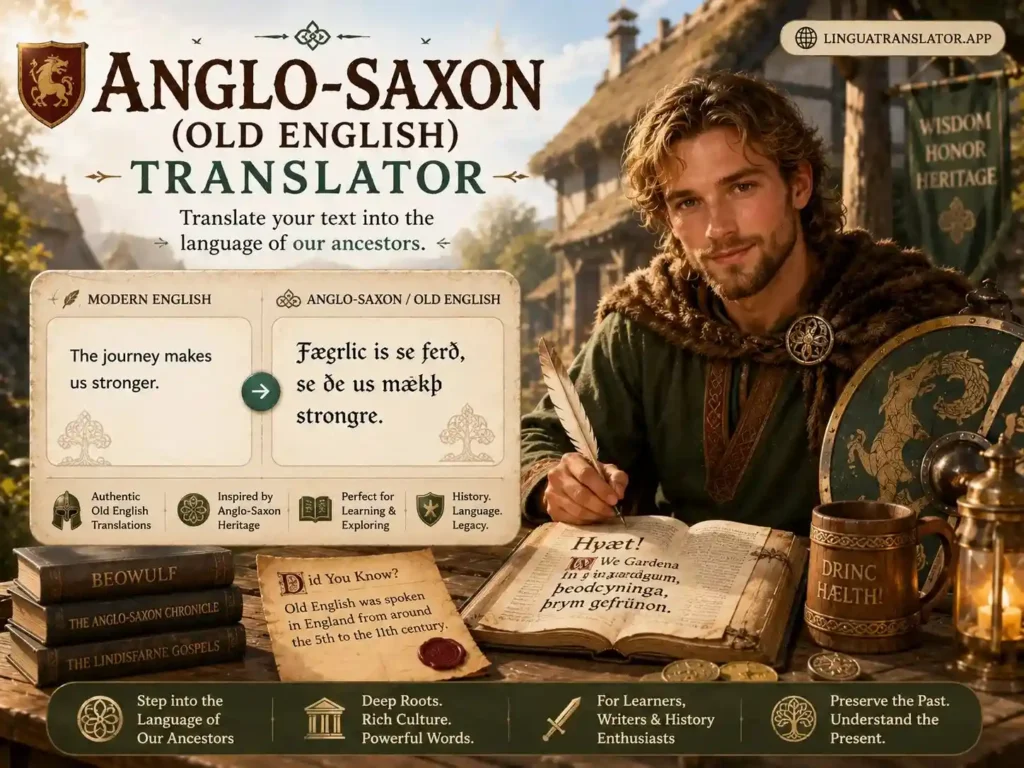
Fantasy Translator
Anglo-Saxon/Old English
Translates text into an approximation of Anglo-Saxon/Old English style
What Is an Anglo-Saxon Translator?
An Anglo-Saxon Translator is a specialized tool designed to transform modern English into authentic Old English, or Anglo-Saxon, while preserving meaning. Unlike general “medieval” or “Shakespearean” translators, it focuses on the grammar, vocabulary, and stylistic features unique to Anglo-Saxon. From my experience working with historical texts and epic literature, the key to a reliable translator is that it respects cases, verb conjugations, and sentence structure, rather than simply replacing words with archaic alternatives. This tool ensures that translations feel genuine, readable, and stylistically accurate.
Why Learn or Use Anglo-Saxon (Old English)?
Old English is more than a historical curiosity. It helps us understand the roots of modern English, the etymology of words, and the culture of early medieval England. Many words we use today—like house (hūs), king (cyning), or friend (freond)—come directly from Anglo-Saxon. Writing or reading in Old English can also make creative projects, games, or literature feel authentic and immersive. I personally enjoy using Old English for writing epic stories or role-playing scenarios because even a simple sentence feels dramatic and heroic when phrased in true Anglo-Saxon.
How the Translator Converts Text Into Old English
The Anglo-Saxon Translator works by analyzing the meaning and structure of your modern text and then reconstructing it using the vocabulary, grammar, and style of Anglo-Saxon. Old English had noun cases, genders, and strong versus weak verbs, which are very different from modern English grammar. For example:
Plain Modern English: “The king rules his people with honor.”
Old English (Anglo-Saxon): Se cyning rīcsode his folc mid ārwurðnesse.
Plain Modern English: “I will defend my land.”
Old English: Ic wille min land weardian.
Notice how the translator preserves meaning while applying authentic grammar and word order, which is what makes it a true Anglo-Saxon translation rather than just a stylized “medieval English.”
Translate Any Language Into Anglo-Saxon
One of the most impressive features of this translator is its ability to handle multiple input languages. Whether your text originates in English, French, Spanish, or another language, the tool reconstructs it in authentic Old English, maintaining meaning and context. This is particularly useful for historians, writers, and content creators who want to give their texts a historical, epic, or literary flair. I’ve often experimented with translating simple conversational phrases into Old English, and even short sentences immediately gain a sense of gravitas and drama.
Why Anglo-Saxon Language Is Unique
Anglo-Saxon is not only the foundation of modern English but also a highly expressive, poetic language. It is characterized by:
- Alliteration and rhythm – commonly used in epic poetry like Beowulf.
- Strong verbs and noun cases – giving sentences precision and flexibility.
- Compact, vivid vocabulary – a single word often conveys meaning that modern English would require multiple words for.
Using Anglo-Saxon in your writing or projects adds historical authenticity, literary depth, and stylistic uniqueness. From my perspective, even translating ordinary phrases can make storytelling feel immersive and powerful, because the rhythm and word choice in Old English carries a natural weight that modern English lacks.
Built for Human-Like, Authentic Output
Many translators claiming to create “Old English” produce text that is either grammatically impossible or merely modern English sprinkled with archaic words. This Anglo-Saxon Translator focuses on human-like, historically accurate output, making sentences readable yet authentic. The tool respects grammatical structures, verb forms, and stylistic norms of Anglo-Saxon, so your translations don’t just look old—they feel like genuine Old English text.
Who Can Benefit from an Anglo-Saxon Translator?
This tool is perfect for:
- Writers of historical fiction or fantasy
- Role-playing game creators
- Students studying Old English or medieval literature
- Educators designing engaging language exercises
- History enthusiasts and hobbyists
Its simplicity makes it accessible to both professional and casual users, allowing anyone to explore the richness of Anglo-Saxon (Old English) without needing a deep linguistic background.
Simple, Fast, and Engaging
Using the translator is straightforward: paste your text, click translate, and instantly receive authentic Anglo-Saxon output. There’s no need for specialized knowledge of grammar or vocabulary, yet the output remains faithful to historical structures. From my experience, tools like this make learning and experimenting with Old English fun, educational, and highly satisfying.
Examples of Anglo-Saxon Translations
Plain Modern English: “I will fight bravely.”
Old English: Ic feohtan cēne.
Plain Modern English: “Hail, my friend.”
Old English: Hāl, mín freond.
Plain Modern English: “The warriors are strong and loyal.”
Old English: Þa wīgend sind strang and hold.
Even simple sentences gain a sense of heroism, drama, and authenticity when translated into Old English, making them perfect for storytelling, games, or creative projects.
Start Using the Anglo-Saxon Translator Today
If you want your writing, storytelling, or creative projects to capture the authenticity, rhythm, and power of early medieval England, the Anglo-Saxon Translator is the perfect tool. Convert modern text into Old English instantly and give your words a historic, epic, and literary voice.
Try the tool above and let your sentences echo like the sagas and epics of the Anglo-Saxons.