Free Medieval Knight Translator – Convert Text to Knightly Speech
The language of knights, chivalry, and medieval courts has a distinct charm that instantly transports readers to the world of castles, jousts, and honor-bound warriors. Our Medieval Knight Translator allows you to transform ordinary text into the style of speech used by knights, nobles, and heralds of the Middle Ages. Whether you are writing historical fiction, game dialogue, role-playing scripts, or simply want to add a dramatic flair to your words, this tool brings the medieval era to life in your writing.
Curious about the history of medieval and fantasy languages? Read our guide to the 10 Best Fantasy Languages for Writers and Worldbuilders.
Fantasy Translator
Medieval Knight
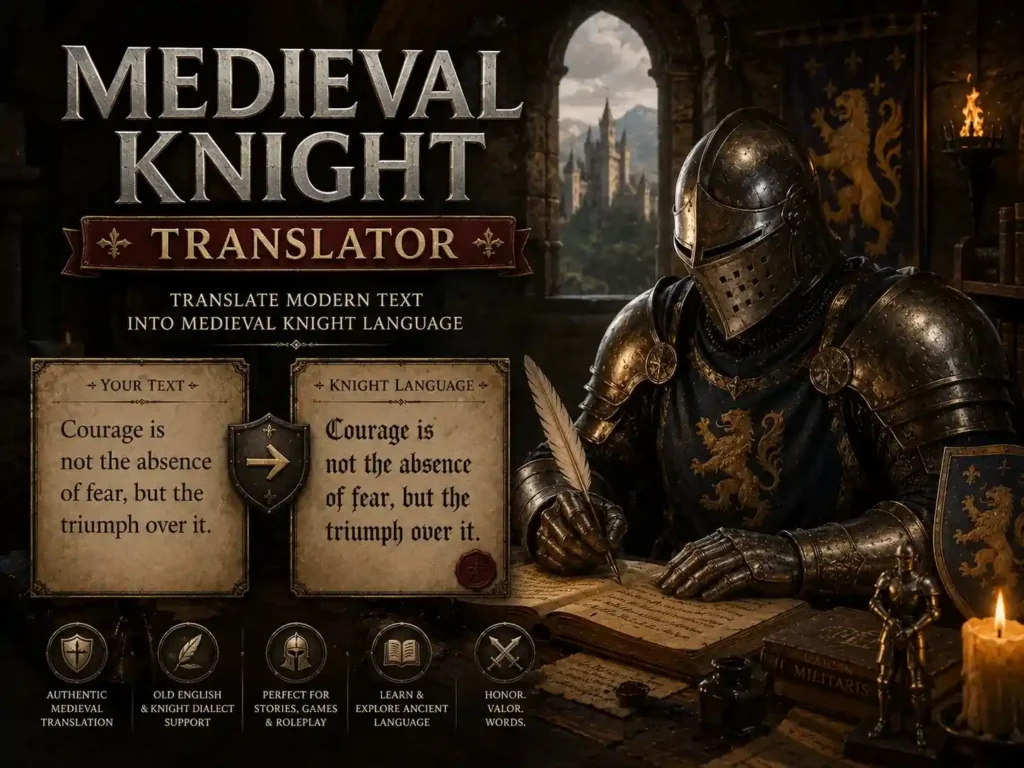
Translates text into the speaking style of a medieval knight
What Is a Medieval Knight Translator?
A Medieval Knight Translator is more than a novelty tool—it is a stylistic converter that captures the diction, tone, and rhythm of medieval English. Unlike ordinary text transformers, this translator focuses on vocabulary, sentence structure, and stylistic flourishes that knights and noblemen might have used. The difference between a weak translator and a professional one is the attention to how phrases were actually spoken or written in medieval times, not just replacing modern words with archaic synonyms.
How the Translator Converts Text Into Knightly Speech
When a sentence is run through the translator, it is analyzed for meaning, tone, and context. Simple greetings, commands, or declarations are rephrased to reflect the formal and expressive style of knights. For example, a plain sentence like “Hello, how are you?” becomes “Hail, good sir! How doth thy day fare?” Notice how the greeting is more elaborate, the verb forms are period-appropriate, and the structure evokes the ceremonial language of the era. This tool works particularly well for creating dialogue in medieval-themed stories or games because even a short sentence can feel epic and immersive when written in knightly style.
Translate Any Language Into Medieval English
One of the most impressive aspects of this translator is its ability to convert text from any language into medieval English that feels authentic. Whether your source is modern English, Spanish, or another language, the tool preserves meaning while adopting medieval phrasing. This ensures that your sentences not only convey the intended message but also transport readers to the chivalric world of knights and noble courts. Maintaining both clarity and period-appropriate style is what makes medieval dialogue compelling and believable.
Why Medieval Knight Language Is Special
The appeal of medieval knight language lies in its formal, dramatic, and honorable tone. Knights were trained in rhetoric and etiquette, so their speech often carried weight, respect, and poise. Using this language in writing adds a sense of gravitas and adventure. In stories, social media role-playing, or even creative content for blogs, knightly phrasing stands out because it is both memorable and entertaining. Experimenting with the translator to give ordinary statements a heroic touch which can make dialogue feel cinematic even in casual writing.
If you enjoy historical and fantasy style translators, you might also love our Shakespearean Translator for elegant Elizabethan English, or our Anglo-Saxon Translator for the ancient roots of Old English.
Human-Like, Readable Output
What sets this Medieval Knight Translator apart is its human-like output. Many tools simply replace words with archaic alternatives, producing text that feels awkward or forced. This translator, however, considers sentence flow, tone, and context to generate text that is readable, natural, and dramatically effective. It is suitable for creative writing, game scripts, role-playing scenarios, and even educational exercises exploring medieval language and history. The ability to balance authenticity with readability is the key difference between an enjoyable translator and a gimmick.
Who Can Benefit from a Medieval Knight Translator?
This tool is ideal for writers, game developers, educators, and hobbyists. Writers can craft dialogue for knights, lords, and heroines; game developers can enhance in-game conversations with authentic medieval style; educators can use it to teach historical language in an engaging way; and casual users can have fun experimenting with epic, knightly speech. Its simplicity ensures that it is accessible to everyone, from professional writers to hobbyists exploring the world of medieval fantasy.
Simple, Fast, and Effortless
Using the translator is straightforward. You enter your text, click translate, and instantly receive knightly English output. There are no complicated steps or settings to learn, which allows users to focus on creativity rather than technicalities. This ease of use encourages experimentation, letting me quickly test dialogue, craft narrative scenes, or generate entertaining medieval-themed content without breaking my workflow.
Examples of Medieval Knight Translations
Plain Modern English: “Are you ready for battle?”
Medieval Knight Translation: “Art thou prepared to meet the fray, noble warrior?”
Plain Modern English: “I will help you.”
Medieval Knight Translation: “I shall lend thee my aid, good sir.”
Plain Modern English: “Hello, my friend.”
Medieval Knight Translation: “Hail, mine honorable companion.”
Notice how the translator enhances tone, diction, and sentence structure, making each phrase feel ceremonial and dramatic. It doesn’t just replace words—it recreates the atmosphere of medieval courts, battlefields, and noble gatherings.
Start Using the Medieval Knight Translator Today
If you want your text to feel heroic, formal, and reminiscent of the medieval era, the Medieval Knight Translator is the perfect tool. It instantly transforms any ordinary sentence into knightly language, adding drama, sophistication, and authenticity to your writing. Try the tool above and let your words echo with the honor, valor, and grandeur of the knights of old.
Ready to speak with the honor and valor of a true knight? Use our free Medieval Knight Translator above to instantly transform any text into authentic knightly speech. No sign-up required — just enter your text and translate.
Explore our full collection of Fantasy Translators for more creative language tools.
FAQs
RELATED POSTS
Yoda Style Language Translator – Speak Like a Jedi Master
Reverse your sentence structure, this tool will. Ancient wisdom and Jedi humor to any message, it adds.
Parseltongue Translator – Speak the Serpent Tongue of the Dark Arts
Speak the language of the High Elves. Convert English into Tolkien’s most elegant Elvish tongue — beloved by Middle-earth scholars, fans, and tattoo seekers.
Alien Language Translator – Convert Text to Alien Language Free
Communicate beyond Earth. Transform any text into a mysterious, futuristic alien language style — perfect for sci-fi writers, game developers, and worldbuilders.